Showing posts with label books. Show all posts

Saturday, October 16, 2021

A Reading on Writers Radio

An exciting announcement -- I am going to be reading from my novel, The Age of Grandchildren, on Writers Radio. The program will air every hour on the hour from October 18 to 31. 

Hosts Carole Harmon and Ingrid Rose, and technical producer Gary Sills, are the creative minds behind Writers Radio. They host interviews and readings by all manner of writers, produce the programs, and air the them on their online radio, writersradio.ca. The writers' pieces are interspersed with selections of Gary's music.

My reading has been paired with a reading by friend and fellow writer, Gail Madjzoub. Although our novels are quite different in many ways, Gail and I both explore the experiences of young women coming of age in rigid societies, what it means to be seen as an outsider, and the personal costs of following an ethical path. Host Carole Harmon has titled our program Liberty's Children

Gail will read first, and here is how Carole introduces her book:

Gail Madjzoub

CRIMSON INK : A Novel of Modern Iran

1955-2011 

Based on historical facts, Crimson Ink traces the multi-generational interweaving of three Iranian families through decades of great social change and upheaval. The novel is grounded in Gail's knowledge and experience of living within an extended Iranian Baha'i family over the course of her twenty year marriage.

The setting of Gail's reading is in the city of Shiraz, Iran. It’s early Autumn of 1955. The country is gradually emerging from the throes of its most recent clergy-led pogrom against its largest religious minority, the Baha’is.

Six year old Fareshteh and her mother Farah set the stage for the turbulent events to come.


My reading rounds out the program. I read three brief excerpts from my speculative fiction novel, The Age of Grandchildren. This is how Carole describes my book: 

Judith Lapadat

THE AGE OF GRANDCHILDREN

Judith Lapadat's coming of age novel takes place in the imagined near future, in a world ravaged by climate change. Best friends Becca and Honor have grown up in an all-female collective sheltering beneath the ruins of a bombed university. 

Honor is a runner who carries trade packages to the wall surrounding their shelter, Becca is her watcher. Mother Stella is their group leader in this closed society. Judith's readings take place over a two day period which will awaken the girls to aspects of their world they have never suspected.

***

To tune in, go to writersradio.ca and click on the play button anytime between October 18 and October 31. If you don't have a chance to listen during this time frame, our program will be archived afterwards on the Writers Radio website as a podcast. If you would like to receive announcements of upcoming programs, you can also subscribe to Writers Radio. It's a great way to support this wonderful initiative.


Tuesday, December 8, 2020

Author Interview: Gail Madjzoub

Author Gail Madjzoub

Today, I am delighted to bring you an interview with the author, Gail Madjzoub. Gail is currently based on Vancouver Island in British Columbia, Canada, but she has spent her life living all over the world.  

Gail is a member of my writers' group. I had the opportunity to serve as a preliminary reader for her recently published novel, and was very pleased when Gail agreed to do an interview with me for Dr Sock Writes Here.


Jude: 


Your novel, Crimson Ink, spans a period of more than five decades in modern Iran. Tell us, briefly, what the novel is about.


Gail:


After the Islamic Revolution, Fereshteh, a woman doctor and a Baha'i, experiences along with her family and religious brethren far greater than usual persecution for their beliefs; they struggle to survive. Compassion for the countless others who also run afoul of the regime prompt her and her physician husband to treat those emerging from the torment of prison in the ‘80s and again following the chaotic aftermath of the 2009 election. 


Meanwhile, Fereshteh joins forces with others to help women enduring not only the regime’s oppression but also domestic abuse. Her work and her religion become the pretext for her imprisonment and worse. This has unintended consequences for other family members, yet there is resilience and there is hope.


Jude: 


The story is told from several points of view. As a writer, what strategies did you use to provide narrative structure and coherence, given the various points of view and long timeline?


Gail:


To help readers make sense of the large cast of characters from three different Iranian families (all with names unfamiliar to a Western reader), I created family trees, bolding the names of those who are important, especially whose point of view drive the story. At the end I added Glossaries and References.


To manage the long timeline I grouped chapters into “Books” that reflected eras: Pre-Revolution (1955-1978), Revolution (1979-1980), Post-Revolution (1989-1993), “2008”, and Reform (2009-2011). Within these I selected only significant years, months and seasons, showing each family separately but simultaneously up until 2008. Only during the final three years of the narrative do all three become inextricably intertwined; their interaction then drives the plot to its climax and resolution.


Jude: 


One of the themes in the novel that I found very interesting is the complexity of family. Could you talk about that?


Gail:


The main characters come from a large extended family split down their religious lines: a Muslim brother and a Baha'i sister. While the sister’s family embraces everyone, it’s only because of the brother’s love and loyalty to his sister, despite what he considers her religious ‘defection’, that he and his family tolerate hers. Sinister undercurrents, and secrets and betrayals born of fear carry grim consequences for many, some of which emerge only over decades.


In the second family, the one fair-minded son finds he can’t escape his family’s legacy. This and the Revolution tether him to a path that causes him to forget who he is.


The third family produces a son out of squalor, desperation and neglect. His eventual reconnection with his powerful cleric father gives him free reign for his yet undiscovered aberrant proclivities. His dealings with and marriage into the first family, and his professional relationship with the son from the second family complicate all relationships in unforeseen ways. 


Jude: 


Although your story is fictional, it speaks about real political and social events. What challenges did you face in meshing fact and fiction?


Gail:


Historical events created a solid framework for the story and details of these helped fill it in. It was actually easy for me to fit my fictional characters and their personal stories into this. They’re a mix: composites of real people whose stories I knew or read about, and purely fictional ones based on probable personality types likely to be found within such a narrative.


The real challenge was balancing my portrayals of characters and events. I didn’t want to get into the quagmire of politics and known personalities, nor did I want to reduce characters, politics, social justice and religion to simple black and white depiction. All are complex and I saw my task as providing nuance and opposing perspectives without becoming dogmatic. This took a great deal of time. Discussions with early readers helped me in this.


Jude: 


There are many routes to publishing. What approach did you take, and why?


Gail:


I researched all possibilities and had conversations with other writers. Then sat on the fence for a long time. Finally, after forays into the world of query letters, agents and publishers, consideration of the issues with publishing contracts, intellectual property rights, the long timelines, and possible frustrations of being at the mercy of other peoples’ demands and delays, I felt that self-publishing was the only route for this book. It had taken me many years to research, write and edit, and I wanted it to be published on my own terms and timeline.


Jude: 


Are you working on a writing project now? Can you say a few words about it? 


Gail:


 Yes. It’s a sequel to Crimson Ink. I’d thought I was done with the story, but in early 2020 I realised this wasn’t so. In light of current events my characters were agitating and telling me they had more to say. Iran has become increasingly harsh in its treatment of many of its citizens, particularly women and minorities. Social justice questions continue to loom large. In my sequel, at least, I can bring some resolution to a couple of the issues I addressed in Crimson Ink.


Jude: 


What advice do you have for writers, either about writing or publishing?


Gail:


You can write at any age. I’m a late bloomer, having started when I was 50. You simply must have passion and the courage to set words onto a page. And now, many years later I also know that you can learn about and navigate the publishing game. There’s a wealth of information and tools out there. You can learn new technology: how to use writer-specialised software, software for formatting a manuscript, the ins and outs of self-publishing, and social media as a marketing tool. If you want your book published, you will learn how to do it. 😊


Bio: Originally from the American East Coast, I lived & worked for more than 30 years in Europe and Africa & have traveled extensively.  After settling again in North America I began writing.  My professional background includes education, health care, life coaching & facilitation.


To follow Gail’s writing updates click here:

Website: https://www.gailmadjzoub.com

Instagram: Gail Madjzoub  

Facebook:  Gail Madjzoub, Author

Email:  gail@gailmadjzoub.com


The book is available on all Amazon sites.


Sunday, June 28, 2020

On Writing a Trilogy

Piper's Lagoon
I didn't set out to write a trilogy. In fact, the idea of writing one novel seemed pretty intimidating. How would I ever construct such a long document, and keep the whole thing coherent?

My first attempt at writing a novel was about 20 years ago or so. It was a story told from the perspectives of three women who lived on the same street but didn't know each other very well. Each was going through a difficult period in her life, and each was trying to keep her troubles secret. As things got worse for each of them and the polished surface of their lives cracked open, their secrets ceased to be secrets and the women became entangled in each others' lives. I wrote about 2/3 of the first draft, and then I got stuck. I didn't know how to draw all the threads together.

I went to a week-long writers' retreat to try to work through it and finish the novel, and instead started writing another novel.

With this next novel, I managed to finish a very long first draft, which I sent out to some preliminary readers who were kind and helpful. But I became overwhelmed by the massive revisions that needed to be done. Although the story had good bones, almost the whole thing was told from the inside of the main character's head, plodding and slow. The story is about returning from the city to one's childhood home because of the death of a parent. The main character grapples with challenging family dynamics. Then an accident keeps her there much longer than intended, and plunges her back into childhood memories and a ultimately yields a more mature perspective on the family and community that have shaped her. 

So, stuck on the revisions, what did I do? Yes, you guessed it; I started writing another entirely different novel.
Brickyard Bay

This one is speculative fiction, and it takes place in the near future. A group of girls and women have survived an apocalyptic event that has destroyed their society by sheltering underground for many years. It's written from the perspective of two best friends who are coming of age. Each separately faces the choice of whether to stay and try to save her community or find a way out and take her chances in the dangerous unknown lands on the outside. The novel explores themes of power dynamics, friendship, personal integrity, and motherhood.

I have recently completed a third draft of it. My revisions incorporate the feedback from six incredibly helpful preliminary readers, as well as lots of the suggestions given by members of my writers' group over the last 2 1/2 years. My next step with this novel is to take steps to get it published. I have written about this novel here and here.

Spelunking
But, meanwhile, as I wrote this novel, I kept thinking, "I wonder what happened to their world that forced them to have to shelter underground?" A little bit of that story is included in the novel in the form of flashbacks and storytelling events recounting their history. I kept writing background notes about the time before they went into the shelter. And then, all of a sudden, the entire plot line for a prequel novel popped into my head and I wrote it down.

So, last year while my first draft was out with the preliminary readers and I was waiting for their feedback, I started another novel, the story of how the world fell apart and how the women ended up in an underground shelter. I have written about 1/3 of the first draft. You can read a brief excerpt here.

The other thing that happened is that as I was coming to the end of the novel about the women in the shelter, I found that the novel was getting longer and longer but there were several really interesting plot threads that I could not bring to a satisfactory conclusion in the space of the novel. The solution to that problem was. . . yes! You guessed it -- to write yet another novel, a sequel.

So that is how I came to be writing a trilogy: a prequel novel, which I'm partway through writing, the middle novel in the trilogy which is ready to go out for publication, and a sequel novel.
Little Qualicum Falls

Although a few elements in the sequel were clear and I knew how I planned to resolve them, the overall story line was quite hazy to me until about a two weeks ago. Suddenly, the plot line for the third book revealed itself to me, along with the main characters and events, and I wrote it down. 

It seems miraculous how the story suddenly appears like that. But then again, perhaps it's not so surprising. I think about the story for the hours and hours I spend in front of my computer writing and revising day after day. During periods that I'm actively writing, I walk around with my head in the clouds thinking about my story all day long. My characters infiltrate my mind when I'm trying to get to sleep at night. My brain is chugging away much of the time trying to turn my made-up world, my characters, and the events I've already invented into a coherent narrative. So although it feels like the story just pops into my head, in fact, I've been ruminating on it for years.

One of the fascinating things about writing a trilogy is going back and forth between the three stories. There is a character, Mother Beulah, in the completed novel who is important but not a main character. However, in the prequel novel, Beulah is a main character and many of the events are seen from her point of view. I learned more about Beulah as I worked on writing the prequel novel, and was able to go back and deepen Beulah's character in the middle novel while doing my revisions on it.

Writing a trilogy allows me to include more characters and points of view than I could in a single book. It allows me to follow characters in different periods of their lives and different circumstances -- e.g., the younger Beulah and the middle-aged Beulah.

Where I Write
But it's also challenging because it's harder to remember and hold together the details of the story world and the characters across three books. As well, I am writing the three books so that each of them can be read on its own in any order without having to depend on the information that was in a preceding book. Although each is or will be an intact, complete story, there are certain themes, events, and characters that run across the trilogy.

I have learned a lot from each novel I've written or attempted to write. Writing and revising are very time-consuming processes but I think doing them is the only way to really learn how to write.  

Maybe some day I'll be able to go back and finish those first two novels. Or maybe I'll have gone on to writing something else by then.

It's hard to illustrate a blog post on writing, because all the visuals of the novels are in my head or in words on the page. I've included a photo of my desk where I write. Although I spend a lot of time writing, I do other things too. So I've included a few photos of the amazing landscapes of Vancouver Island from recent excursions.

Saturday, November 2, 2019

Where Were You a Year Ago?

I can remember exactly where I was a year ago. Can you?

Last October, Rob and I spent a few lovely weeks in Portugal. I wrote about it here, here, and here. But what I never wrote about on the blog was where we went after we left Portugal.

This is where we were last Halloween. Can you guess where it is?

A Fabulous Way to Spend Halloween
 Yes, we went to London, England! This photo shows us in front of the Palace Theatre in London. The day we arrived in London, the cab driver drove us right past this theatre on our way to our hotel.

Now, I am a huge Harry Potter fan. I read them aloud to my children as the books came out one by one. As they became independent readers, I confess we used to squabble over who got to read each new book first. I saved the set of books, and now my daughter is reading the series with my oldest grandson.

Of course, we also raced out see each movie as it was released. My teenage son and I went to see Harry Potter and the Order of the Phoenix in Kindersley, Saskatchewan, as we travelled across Canada in our antique RV in 2007.

So when I saw that Harry Potter and the Cursed Child was playing in London while we were there, I became obsessed with attending the play. I went online and found out the tickets had been sold out for months. But I also read that it was sometimes possible to purchase tickets that someone else had returned the morning of the play.

So we walked over to the Palace Theatre on the morning of October 31, arriving at the ticket wicket a little after it opened. No one had returned any tickets yet, but the salesperson directed us to stand on the sidewalk and wait. We were second in line! We waited for over an hour. The person in front of us got tickets. Finally we were called over to the wicket and offered a pair of very expensive tickets just a couple of rows back from the stage. We bought them! They were the most expensive event tickets I've ever purchased.

Inside the Palace Theatre
Watching the play was an all-day affair. Part 1 started at 2:00 PM and lasted over 3 hours. We had a break for dinner, then had to be back at the theatre at 7 PM for Part 2, which lasted about 3 1/2 hours. It was fabulous!

Altogether, we stayed five days in London before flying home.  Both Rob and I had been there decades previously, so we spent a lot of time walking around to the famous sights to see what had changed. One of the highlights for me was visiting the National Gallery, especially the Turner paintings and the Impressionist Show.

Detail of Floor Mosaic in the National Gallery
Vincent Van Gogh


We also loved the Museum of London, one which neither of us had ever been to. It was recommended to us by someone we met on the port cellar tour in Porto.

A Section of the Original City Wall, Close to the Museum of London

Detail of Trafalgar Square
London Phone Booth
I leave you with a few photos from our visit. I have so many, it's hard to choose. To conclude, here's a photo from Halloween, this year. I went our Trick or Treating with my grandsons, their parents, and their friends.
Halloween 2019
One final note: I've signed up for NaNoWriMo this November. If you're curious about what it is, I've written about it before here and here. So, I'm going to be spending a lot of time at my keyboard this month, but you'll probably not be hearing very much from me in the blogging world for a bit.

Sunday, March 17, 2019

A Plan to Reverse Global Warming

A Path Through the Forest

What Can I Do?

In a recent blog post, I wrote about my sense of helplessness and personal paralysis as I considered what I can do to help address global warming and climate change. The problem is huge and multi-faceted, and change on a global scale is urgently needed for humanity's survival (or, perhaps more accurately, the survival of human civilizations).

As a single individual, I cannot solve climate change. But I can do my small part to make a difference, to the best of my ability.

So where should I put my efforts? What actions would have the biggest impact, match my particular knowledge and skill set, and be within the scope of what I can actually accomplish?

Although I have been slowly educating myself about the challenge of global warming facing us as a species, I decided that I needed to do some reading about not just the challenge facing us, but about possible solutions.

Drawdown

So I ordered the following book from the library: Drawdown: The Most Comprehensive Plan Ever Proposed to Reverse Global Warming. It arrived a couple of days ago. This book, edited by Paul Hawken and published in 2017, was a New York Times best seller in 2018. There also is a website that is even more extensive and up-to-date than the book at www.drawdown.org.

So what is "drawdown?" The website defines it this way: "Drawdown is that point in time when the concentration of greenhouse gases in the atmosphere begins to decline on a year-to-year basis." Once greenhouse gases begin to decline, the warming of the planet will begin to reverse.

The book sets out 100 global strategies, which, if we implement them all by 2050, will enable us to reverse global warming. The strategies are in the following categories: Energy, Food, Women and Girls, Buildings and Cities, Land Use, Transport, Materials, and Coming Attractions (promising future technologies and solutions).

All of the approaches (except the last category which is more speculative) already exist and have been rigorously researched and modeled by a team of more than 200 scientists and other specialists from around the globe. Each one is ranked in terms of how many gigatons of carbon dioxide (and other greenhouse gases) will be reduced by 2050 using that solution, an estimate of how much it will cost to implement, and what the net savings will be. By reduced, I mean either CO2 that will be removed from the atmosphere, or CO2 that would be added if we continue on our current course but that we will avoid adding if we use this solution.

In the book, they have adopted a conservative bias -- that is, left room for error if the proposed solution is not quite as effective or adopted as readily as the scientific evidence suggests is plausible. 

Upon receiving the book, I looked at the Table of Contents and how the book was organized. I read the brief Forward that described the purpose of the book and the assumptions they worked within. Then I flipped straight to the back of the book and read the table of statistics (yes, I'm a nerd).

The numbers show that, by 2050, in the Plausible Scenario (the outcome that we should be able to achieve with good effort), we will be able to reduce 1,051 gigatons of carbon dioxide. That will not get us to drawdown or reversal of global warming. In order to reach drawdown, we will need to reduce carbon dioxide by 1442.3 gigatons. This is the Drawdown Scenario, and they describe how it can be achieved. They also show an Optimum Scenario -- one where we are able reduce carbon dioxide by 1612.9 gigatons.

I also skimmed through the brief bios of the 200 scientists and other experts from around the world who contributed to this research and plan.

My Initial Response

 My first thoughts on getting this far with the book were:
  • a huge sense of relief that so many really smart people with appropriate backgrounds are working on developing solutions and a plan
  • surprise at the wide range of human activities that are currently contributing to the problem, and the practical solutions in each area. 
  • a dawning realization that we have to work on the problem of global warming on many fronts simultaneously -- electric cars, solar power, and wind turbines are not by themselves a solution. They are only part of the solution. 
  • surprise to see that the data shows that the net savings of implementing "greener" solutions exceeds the costs. That is, green solutions are in most cases less expensive than what we are currently doing. 
 I also appreciated that the book is very engaging and interesting to read, not dry and technical as so many reports about climate change and policy frameworks tend to be. It is beautifully illustrated with photos of different landscapes and cultures around the world.

So I dived into the meat of the book.

Drawdown, Open to the Section on Food

Food

I decided to start with the section on food, because I am very interested in food.

I was surprised to learn that a broad-based switch to eating a plant-rich diet is one of the most effective ways of reducing greenhouse gases -- ranked 4th of the 100 solutions. They point out that our "Western diet comes with a steep climate price tag," noting that raising livestock accounts for 15 to 50 percent of current greenhouse gases emitted each year. A large proportion of this is because of the deforestation that takes place in order to create grazing areas for cattle, in particular.

They report that the average Canadian and American eats more than 90 grams of protein each day, much of it from meat and animal products. An adult's daily protein requirement is 50 grams and all or most of it can be obtained from plant-based foods.

They recommend reducing meat consumption and avoiding overeating by restricting calorie intake to 2500 calories per day, on average. Citing Thich Nhat Hanh, a Zen master, they say, "making the transition to a plant-based diet may well be the most effective way an individual can stop climate change."

As I have written here before, I eat a healthy well-rounded diet that includes meat. But this book convinces me that reducing my meat consumption is something immediate and positive with respect to climate change that I as an individual can do.

Another astonishing source of CO2 in the atmosphere is from food wastage. More than a third of the food we grow or raise every year in the world is thrown away, primarily in high-income economies. Yet around the world people are going hungry.

The wasted food contributes the equivalent of 4.4 gigatons of carbon dioxide every year. If we used the food instead of throwing it away, globally we could reduce the need to clear more land to grow food, which causes deforestation. Reversing food wastage is ranked third of the 100 solutions in terms of carbon dioxide reduction. If by 2050 we only threw away half as much food as we do presently, we could reduce CO2 by 70.5 gigatons, they say.

Some of the other topics I have read about include farmland restoration (#23), clean cookstoves (#21), multistrata agroforestry (which means planting crops under trees) (#28), improved rice cultivation (#24), growing rice using the system of rice intensification (#53), and silvoculture (grazing livestock in forests) (#9).

There are still several other strategies that involve food and agriculture that I have yet to read about. It is interesting to discover that so much of our greenhouse gases come from our systems for raising and handling food.

Michael Pollan's advice: Plant a food garden in your yard or community. Because of our industrialized approach to agriculture, every calorie of food produced requires 10 calories of fossil fuels to produce it. Therefore, he says, growing your own food is one of the most powerful things you can do. 
 
Why It Matters

To me, the reason that it is imperative to take action is that the well-being of future generations rests on the choices we make right now. Every month that we delay, we pump more greenhouse gases and particulate into the atmosphere. Some of them, like carbon dioxide, remain in the air for decades or even centuries. Others, like black carbon, only stay in the air for eight to ten days, but hugely accelerate the warming effect when they are present.

Taking action now means that our grandchildren and our loved ones' grandchildren will inherit a beautiful world in which they can thrive. The alternative, if we do not take action, is too horrible to contemplate.

I'll leave you with some photos of me on a recent hike with my son and daughter.

Friday, November 30, 2018

Art Show Update and Novel Newsflash

Since returning from our European trip (here, here, here, and here), I have had the chance to relax at home, socialize with friends, and spend some great moments with the grandkids.

Relaxing on the Couch, with Coffee

Sleep over at Grandma's
 

And, we had some great visits with friends and our northern family members throughout August, September, and October too, including a visit from blogging buddy Liesbet and her husband  Mark. I just haven't had time to write about everything that has been happening!

But, that is not what this post is about.

Art Update

This Saturday and Sunday, I will participating in another Studio Tour. As with last time, I will open my art studio and gallery, Notch Hill Art, to the public. I hope to see lots of new and previous visitors! I have blogged about it here
Art Show This Weekend!
 So, I have been busy preparing my studio. I have hung several paintings that I have not shown at previous Nanoose Bay Studio Tour events before. It should be a fun weekend!

Long Shadows


 Novel Update

Newsflash! I have just completed a first draft of my novel.  

It clocks in at 30 chapters and more than 100,000 words. I can’t tell you exactly how many words it is because I have written it using an older version of WORD that stops counting at 100,000. It is a somewhat lighthearted post-apocalyptic tale (if you can imagine that) crossed with a coming of age story.

I am excited about having completed the first draft! I have been working on this novel for about three years, although I actually had the original idea for it nearly 30 years ago when my second child was a baby.

My next step with the novel is to read the whole thing through, making small revisions to do with flow and consistency. Then I am going to give it to my beta readers. I am so happy that four people have offered to read it and give me feedback. They are all people who will present perspectives that I know will be very helpful.

During this past year, my writers’ group has been such a great support and source of feedback. I think that knowing that we will be meeting each month helps to motivate me to keep on working on the manuscript. Every month, I want to have something new to read at our meeting.

The other great thing about our writers’ group (besides the fact that they are wonderful people and good writers) is that we have started to go out to writing related events together, like readings and storytelling evenings. I love being connected with a bunch of likeminded writers.

Next month, I will be reading through the manuscript of one of my writer friends, and I am looking forward to that very much (AFTER the art show).

So, in summary, although I have been actively involved in a lot of things this past year, I have still managed to find some time for writing and art. Writing and making art were two priorities that I set for myself when I retired, and it makes me happy that I have persisted toward these goals.


Monday, November 13, 2017

Why I Enjoy Writing Fiction

Image used courtesy of National Novel Writing Month
November is National Novel Writing Month, aka NaNoWriMo. This year, hundreds of thousands of people from around the world are toiling at their computers trying to write a 50,000 word novel in the month of November. That works out to writing an average of 1,667 words a day every day for thirty days.

I am one of them. Last year I participated in NaNoWriMo as well. I started a new novel, a post-apocalyptic tale about a group of women who have survived in an underground shelter for eighteen years after the global collapse of society. I continued working on it throughout last December and January. Then I set it aside, and did some other things, like renovations, selling a house, buying a house, retiring, and moving. This November, I decided to pick up on writing the novel from where I left off, 50,000 words and 13 chapters into it.

I have been spending hours on it every day. (That is why I have been neglecting my blog.) I am a slow writer. I do not write the way the NaNo website suggests — just flinging words onto the page without worrying about sentence structure, cohesion, or flow. I write carefully, rereading and editing as I go. I build the story brick by brick. That way, when it comes time to go back and revise the first draft, I will have something solid to work with, rather than a mess that seems overwhelming.

I am really enjoying writing this novel. I spend my days in a fog, preoccupied by thinking about my characters and their trials and tribulations. Then when I sit down at the computer, the story just spools out of me.

Why do I love writing fiction so much? It is a good question in this era of the self-narrative, when autobiographical writing, or memoir, or autoethnography is so popular. After all, in memoir, the plot has already happened; you don’t have to make anything up. You have a ready-made story. “This is what happened to me.”

Well, autobiographical writing has a couple of big challenges. Although autobiographical writing, such as memoir, is about the self, every person is embedded in a social context. Therefore, when you write about yourself, you are also writing about people close to you. It is easy to offend, or to disrespect others' privacy. That can be hard, especially when you are in an ongoing relationship with those others that you would like to maintain, or when the things you are saying are negative.

If you write innocuous things about other people, perhaps this issue of privacy is less of a problem, but bland accounts of past experiences do not tend to make very interesting reading. People like to read about conflicts, where there is a villain and a hero, and challenges are faced and overcome. There can be a real temptation to spice up the truth a bit, to add a bit of drama. But in memoir, as Mary Karr says, writing the truth is the fundamental rule that you must not break.

So this is one of the reasons that I love to write fiction. I can make my fictional characters as nasty or as foolish as can be, without the risk of alienating someone in my real life. In fiction, I don’t have to leave out the embarrassing bits to spare someone’s feelings. Really, those juicy details are what make the story.

Another thing about fiction is that you can make the plot do whatever you want. You are not constrained by the history of events as they actually happened, and therein is the true joy of fiction. You get to use your imagination to invent whatever strange world your creative self can envision. You can work out the complexities of your protagonist’s personality, and toss one crazy challenge after another at them, just to see how they behave.

When you write fiction, you pose the question “What if?” What if a group of women lived in a shelter in tunnels and basement rooms under the ruins of a shattered university while lawless gangs roamed through the destroyed city scavenging for material goods? How would this character behave if she was spurned by her lover? What ethical choices would that character face when torn between following the rules of the collective or helping an outsider?

Ultimately, that is the great value of fiction. You can put yourself into someone's circumstances and try to understand how they might think, feel, and act in that situation. Through fiction, you can acquire a deeper empathy for someone unlike yourself. Through fiction, you might just get a little closer to uncovering a truth of human experience. And, most of all, writing fiction is fun!

Where I Write

By the way, if you are a NaNoWriMo participant and you would like to find me, I write under the pen name AnnaHarvey, and my current novel is called The Age of Grandchildren.

Thursday, February 2, 2017

Bye Bye Books


The day after I submitted my letter stating my retirement date, I made a list. Actually, it was two lists in one. The first column listed small renovations and repairs that we might consider doing before putting the house on the market. We have already done a number of things that add value to the house in the five years that we have been here, such as replace the roof, adding a range hood and fan in the kitchen, and so on. (Shout out to Rob!) The house had been newly renovated when we bought it, and the inspection showed that it was a solid house with no issues. So this list is mostly focused on "spit and polish" items that will help it show well.

The other column listed things that we could do to declutter and tidy things up. There are just two of us rattling around in a great big house, but we have a lot of stuff. This is in spite of giving away heaps of stuff (furniture, wood stove, tools, canoe), and throwing away lots of other stuff (old ski equipment, broken toys) when we moved last time. While neither of us is a hoarder, we are very fond of our stuff. Although we have not set a date to put the house on the market or to start looking to buy, we want to give ourselves lots of time for the transition process.

So far, Rob has been the true hero in this endeavour. He already has gone off to the recycling depot with five boxes of old computer parts and cords. He also has climbed into the attic of the storage shed and begun rooting through the old sports equipment (I'd thought we had already gotten rid of that stuff???) and has begun throwing things out (e.g., ancient tents with broken zippers). He also moved a pile of his totes out of the basement storage room, revealing the awful truth that most of the boxes in that room are mine. My stuff that needs sorting comes in four categories: things that belong to my kids that I have been storing for them; boxes from previous moves that I never unpacked; boxes of career related materials (about 25 bankers' boxes in our basement), and books.

I decided to start with the books. Specifically, there was a stack of twelve boxes of books in the spare bedroom, still never unpacked since we moved here. I began unpacking them and sorting through the books, all the while muttering that it seemed ridiculous to be unpacking boxes, knowing that soon enough the books would just have to be packed up again when we move.

It is very hard for me to get rid of books. I have always viewed my books as precious. In the seven frugal years when I lived the life of a poverty-stricken student, books were one of the few luxuries that I allowed myself to purchase. Although I am happy to give books to my kids, or to friends who love to read, or to students, I abhor the thought of books going to the landfill. So, I have a lot of books.

As I unpacked each book, I held it in my hands and thought about who had given me the book, or who had owned it before me, or how that book had shaped my thinking decades ago. And then I asked myself whether I would ever read it again, or if I really needed a book of lists from the 1990's, or a book from the 1980's about pregnancy. I considered whether anyone close to me might want the book. And then, ruthlessly, I sorted many of them into good-bye piles. I have taken two boxes of books to the university to put on the "free books" table for students. I have stuffed the Little Free Library with novels. I have taken four boxes of books to the secondhand bookstore. The bookstore owner took about half of them and said he would give the rest to charities. He tried to pay me for them, but I talked him into letting me take two books from his shelves in exchange. (Uhoh! I'm supposed to be getting rid of books, not acquiring more books!) And, sadly, four boxes of books are going to recycling.

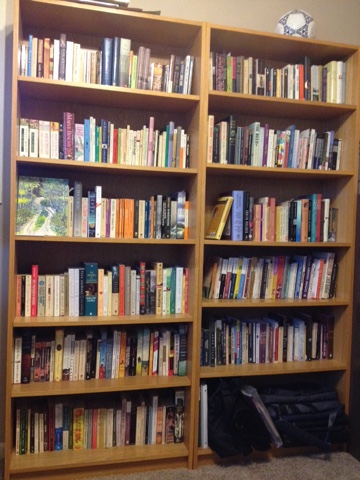
The rest of the books, old friends, have found space on my bookshelves. I have finally found my art books, my poetry books, my gardening books, and my outdoor books! I still have way too many books. I now have three shelves of books, mostly fiction, in my den. There are books in the bedroom, the living room, the kitchen, and the basement. At least fifty of them are books that I have bought or been given but have not yet read. There are about twenty boxes of children's books in the storage room, and I am not throwing out any of those. I have been transporting them, a few each time, to my grandchildren when I go for visits. And then there are three floor-to-ceiling shelves full of books in my office at my workplace. My heroic book decluttering has eliminated just a small fraction of our collection.

The other day, I opened and sorted a box from the basement storage room. It contained, not surprisingly, books, and also a lot of my children's art. For example, I found calendars from twenty years ago that my kids had made me for Mother's Day, and stories they had written. I found the travel diary we had kept when we took a six week trip down the west coast of Canada and the USA in 2001. It took me two hours to sort through one little box because I had to read the diary and every one of their stories, and look at every picture. It sure is a good thing that I move every once in a awhile because I get to rediscover these treasures and take a sentimental walk down memory lane! 


Friday, March 4, 2016

Ru

The following quote is from the book Ru, by Kim Thuy. Her book was the 2015 winner of the Canada Reads contest.


"My parents often remind my brothers and me that they won't have any money for us to inherit, but I think they've already passed on to us the wealth of their memories, allowing us to grasp the beauty of a flowering wisteria, the delicacy of a word, the power of wonder. Even more, they've given us feet for walking to our dreams, to infinity. Which may be enough baggage to continue our journey on our own. Otherwise, we would pointlessly clutter our path with possessions to transport, to insure, to take care of" (p. 41).

From this brief excerpt, so concise and poetic, it is clear why Thuy's book was a winner. I am going to have the great fortune to attend a talk by Kim Thuy next week.

I, unfortunately, continue to clutter my own path in life with possessions, as I have written about here.


Sunday, December 13, 2015

A List: After Susan Sontag

I have been reading Maria Popova's wonderful collection of quotations from writers on writing. You can find it at Brain Pickings. I have read most of these writers, and also several of the books on writing that she quotes from. This morning, I was reading some of Popova's nuggets on list-making as a writing starter activity, and I came across an excerpt from Susan Sontag's As Consciousness is Harnessed to Flesh: Journals and Notebooks, 1964-1980 (a book that I haven't yet read) - her list of "things I like" and "things I don't like." It has inspired me to create my own similar list.

Things I Like:

Coffee, pine trees, our cat Oliver, lady bugs, snow, cheese blintzes, 100 recipe chicken cookbook, red wine, baby clothes, towels, marble, reflections on water, pebbles, mountains, paint, garden soil, new ice, dancing, watermelon, pens, pads of paper, Thai food, fields, hoar frost, yellow, the pattern tree branches make against the sky, pancakes, lists, the letter o, collections of objects, the Gulf Islands, purple violets, The Passing Cloud, K.D. Lang's cover of Hallelujah, cheese, Margaret Atwood, black tea, wood grain, leaves in autumn, butterscotch, words, terriers, rayon fabric, Tsimshian and Haida art, my family, brie. 

Things I Don'Like:

Sewing, green pepper, volley ball, intravenous needles, gore in movies, post-modern art, bullying, perfume, Stephen Harper's Canada, makeup, suicide, maggots, cigarettes, public toilets, undercooked chicken, hospitals, caraway seed, medical procedures on eyeballs, rose hip tea, vomit, foam pillows, nylon, being called a lady or a girl, scotch, frostbite, firearms, gold coloured cars, wire worms, amputations, wet socks, cluttered counters, anime art, haggis, torn medial meniscus, television, grey or beige shirts, litter, dried oolichan, gum recession, hairspray, the smell of diesel, going to work Monday morning, greasy hair, dog poop revealed by melting snow in the spring.

Things I Like:

Good writing of any genre, October, British Columbia, raspberry jam, Rob, cherry blossoms, walking, chocolate cake, magnolia trees, my friends, the Group of Seven, grandchildren, long hair, food columns, jazz singers, alpine areas, pear trees, log houses, pottery, art blogs, blues music, backcountry skiing, kisses, margins, finishing a project, ideas, quilts, swimming in lakes, the camper, language, wild flowers, kayaks, research, cycling, wilderness trails, fly fishing, beets, turquoise, folk art, the angle of the light, beads, view from an airplane window, a wood fire, Haida Gwaii, trees, Mom's shortbread.

Tuesday, October 13, 2015

Memoir and Story

I am reading a book called The Art of Memoir, by Mary Karr. It is a book on writing, specifically about writing memoir. Karr has written three best-selling memoirs helping to popularize the form, and also has spent more than three decades teaching a writing course on memoir. A fundamental premise that is central to memoir, Karr says, is that a memoir demands truth.

She goes on to talk about what she means by truth. She says that "you're seeking the truth of memory -- your memory and character -- not of unbiased history" (p. 11). That is, the truth is not objective truth but the writer's or narrator's truth. She addresses ways in which the mind can be "wiggly" and not fully remember some scenes or events in detail, and also how retold memories (remember the time you did xyz) can insert themselves in your memory as if they were your real memory of the original event. She talks about how the writer can and should signal areas of doubtful memory rather than fictionalizing or, as she puts it, lying to the reader. To be a memoir, the acount must be true. Nothing else will suffice. 

Although I agree with Karr that a memoir must yearn toward an accurate recounting of a remembered event, and that this is how it differs from fiction and also creative nonfiction, I believe that one's memory does not record a "true" record of any experienced event. Rather, even the very first time a person tries to recall an event that occurred, he or she creates a narrative of the event, and that first narrative already has shaped the memory of the event. Essentially, the event has been turned into a story. 

The memory of the event shapes the narrative, and the narrative in turn shapes the memory. With each recall or retelling, the story (and thus the memory) evolves and becomes a little different than it was the previous time. Perhaps the individual doing the recalling now has some new piece of information that sheds a different light on the past experience and therefore gives the memory of it a somewhat different gloss. Or perhaps the memory story is told a particular way to suit a certain audience (e.g., a daughter, or a lover, or a social worker). Or perhaps the adult recalls the event with different developmental insights than the child would have had. Or the event may be remembered differently when one is exuberant and happy than when at the bottom of a pit of depression. 

These different variations of the remembered event layer over each other and each can feel true. Sometime multiple competing versions can feel true simultaneously, or sometimes only the most recent reworking is the memory that feels most true. It may be that there are a few core elements that do not change -- the image of the way the knee was twisted at an unnatural angle, let's say, or the three words the narrator screamed as she ran from the room. But the remaining details and interpretations will vary over time. This slipperiness of memory makes the capturing of one precise truth challenging for the memoirist. 

Consider that as autobiographers, each of us tells a story about our own life that gives our lives meaning. That means that our life story (and therefore the memories it is based on) will be shaped differently depending on whether we see ourselves as the hero, the villain, the victim, the incompetent, and so on. We benignly leave certain bits out and highlight other bits that support this point of view. 

I know that my own life story and my view of myself as the protagonist of my life changes depending on circumstances. For example, I may have led a highly successful project to completion at work recently and received accolades, and for a time, I will tend to recall memories or reshape memories that support my current view of myself as indispensable and a heroic problem solver. Or perhaps someone breaks into my car overnight while it is parked right in my own driveway, and it happens to occur the same week that someone steals my purse out of my office at work. I may for a period of time see my protagonist self as a victim, and begin recalling those times in my childhood that I was taunted at school, or beat up by a sibling, or scapegoated by a teacher. I will call memories to mind that support this new victim view of myself, but also I will inadvertently reconstrue memories to glean evidence for this current view of myself. 

So, I have argued that while a memoirist might strive for the idea of truth, truth itself as presented in one's episodic memories is not that easy to pin down. As a writer, the truth that I reach for is emotional truth. How did I feel when that experience occurred? If I can nail that emotional truth, I am less worried about getting all the facts and sequences right. And as I recount that past event, I also want it to be a good story. That might mean that I compile a series of observations that took place over time into one scene. Or that I have an antagonist say something that perhaps he did not actually say in exactly those words, but that would have been typical of what he would have said. So maybe I'm just not a memoirist, but really a novelist writing novels that are based to a greater or lesser extent on memories. 

Friday, October 11, 2013

Leadership: The Ugly Side

There are lots of articles and books out there on leadership. Inspiring, humorous, or pragmatic and instructive; they come in many forms. Field Wicker-Miurin gave a TED talk a few years ago of the inspirational sort - people from around the world who, through extraordinary dedication and passion, have made a significant difference in their community. She called it Learning from leadership's Missing Manual.

It seems that after a number of years in leadership positions, a person is compelled to write his or her own tome to contribute to the leadership literature. However, I have noticed that there is a book missing from the shelves. My missing manual is not Wicker-Miurin's heart warming perspective, but rather one that would dive into the ugly side of leadership. This book would explore leaders' lived daily experience and the parts too embarrassing or sad to acknowledge to one's colleagues or to eager initiates. I have listed below some (roughly sequential) chapter titles that such a book directed to beginning leaders might include. The alternative chapter titles written in brackets after each chapter heading from Leadership: The Ugly Side are the related euphemistic topics more typically found in leadership literature.


  • Go Find Yourself an Office (Establishing Yourself: The First Test)
  • Jumping onto the Merry-Go-Round (Demonstrating Commitment to the Organization)
  • Deer in the Headlights (The Honeymoon Phase)
  • Getting Dumped On (Learning the Scope of Your Portfolio and Saying No)
  • Saviour or Satan? (Staying True to Your Leadership Style)
  • Lost in the Acronyms (Preparing Well and Doing your Research)
  • Minefield of Organizational History (Learning the Institutional Culture)
  • Sycophants and Concealed Knives (Managing Difficult People)
  • No Time to Pee (Doing More with Less)
  • Golf, Hockey, and Cars: The Old Boys' Network from the Outside (Women in Leadership)
  • Betrayals and Dirty Work (Change Management)
  • Cutting Deals (Relationship Building)
  • Despair and Self-loathing (Coping with Burnout)
  • Shackled to a Merry-Go-Round on Hyperdrive (Time Management)
  • Disappearance of Life Outside of Work (Striving for a Work Life Balance)
  • Health Consequences (Building Fitness into your Schedule)
  • In a State of Numbness (Achieving Equilibrium)
  • Non-Failure (Success!)
  • Dumping it on the New Guy/Gal (Delegation and Mentorship)
  • The School of Hard Knocks (Writing a Book on Leadership)
Looking at the ugly side of the experience of leadership, sometimes it is hard to remember what it is all for. Maybe I should watch Wicker-Miurin's talk again, or go and read another one of those inspirational leadership books. Or maybe I should start writing my contribution to the literature: Leadership: The Ugly Side.


Saturday, March 20, 2010

Reversals, Narratives, and Red Queens


I found this image, Walking on a Dream, at a bilingual poetry website, Poesia torta|Crooked poetry. This blog by Kenia Crissantos from Brazil features poetry (in both English and Portugese) and some great photos. Check it out!

I have been thinking about representation, and especially reflections, doubles, and reversals, since watching the recently released 3D film Alice in Wonderland by Tim Burton. The film combines elements from both of Lewis Carroll's original Alice in Wonderland and Through The Looking Glass, but adds a narrative line not in the books.

As a child, I read and re-read those two books. In Looking Glass, I found the idea of reversals very interesting; images were reversed, time ran backwards, and social actions often were opposite to convention. Also in that book, Carroll took objects with inherent mathematical patterns, like playing cards and chess pieces, and animated them. It has been a very long time since I last read the book. I should go and dig it out of my bookshelf and read it again.

Burton has produced an interesting mashup that reinterprets and extends the two Carroll books. Many of the central events and characters from the books are present in Burton's film, and faithful to the spirit of the original: the White Rabbit, the Cheshire Cat, the caterpillar smoking a hookah, the Mad Hatter's tea party.

But there are significant differences as well. His Alice is a young woman returning to Wonderland thirteen years after her first visit (which is presented briefly in a flashback). As well, Burton's Mad Hatter and caterpillar are much more sympathetic characters than Carroll's, and Burton's White Queen is a different creature altogether than Carroll's. But perhaps the most significant departure is the addition of a narrative line that brings the bizarre tale into conformity with typical North American narrative structure. In Burton's version, Alice becomes the (reluctant) hero who slays the dragon... er... Jaberwocky in a climactic battle, thus rescuing the enslaved populace from the evil Red Queen, and everyone lives happily ever after. It's familiar, and it works.

Burton's Red Queen, played by Helena Bonham-Carter, is fabulous. Many other parts as well are exactly perfect. I loved the movie, especially the 3D version. But maybe it ended just a little too neatly. And there is much more room to have explored the idea of reversals.