Showing posts with label food. Show all posts

Saturday, September 12, 2020

Entertaining in the Age of COVID-19

As the pandemic drags on and on, many of us are trying to find ways to live our lives again, while still following COVID safety guidelines. I'd like to share some of my strategies for hosting friends and family during these very strange times. 

Sunset at Parksville Community Beach

 Following Public Health Guidelines

Before I write about some of my strategies, I'd like to emphasize that I always look at our provincial public health website (BCCDC) first, and follow the guidelines there. In British Columbia, we have been successful at flattening the curve and reducing the infection rate, although during the last three weeks the number of new cases per day has begun to rise alarmingly. Lately, we've had upwards of 100 new cases per day identified, whereas a couple of months ago we were down to as few as 4 new cases a day across the whole province. On Vancouver Island itself, as of today, we've had a cumulative total of 190 COVID cases since the pandemic began.

During the flattest part of the curve, and in congruence with the advice of Dr. Bonnie Henry, our Provincial Health Officer, Rob and I felt comfortable gradually increasing the frequency of our outdoor socializing, and have hosted a number of outdoor get-togethers.

Knowing our Risks and Risk Tolerance

How we have evaluated our personal risk and the risk we pose to others has changed gradually as more scientific knowledge about the virus has become available. So our practices have slowly changed, and might change again should we need to adapt to an upsurge in infection rates. 

We have educated ourselves about what we need to do to stay safe and keep others safe. (See BCCDC  website linked above.) We are fortunate that we live in a semi-rural area and we're both retired. Therefore, we're not subject to possible exposure in a workplace. As well, neither of us has a pre-existing medical condition that puts us more at risk. Our biggest personal risk factors are our ages (64 for me, and 71 for Rob), and the fact that Rob is male. Neither of us is a caregiver for someone with fragile health.

Of course, other people have different risk factors to consider, depending on where they live, their personal health situation, work status, and their household members' circumstances. So consider nothing that I write here as a recommendation; it might not apply to you. Follow your local public health advice instead!

 Where to Meet

Mothers' Day 2020

The short answer to this is -- outdoors! We live in a climatic zone where May through September weather is usually quite lovely, and fine for gathering outdoors. 


One of our first get-togethers was with our daughter and her family for Mothers' Day in May. We met at a local beach. We brought separate food for ourselves and they brought their own picnic. We made sure to maintain two meters (six feet) of distance. 

Over time, we formed a bubble with our daughter, son-in-law, and two grandchildren, so we now share food, sometimes meet indoors, and are more relaxed about the the two-meter distancing.


As well as meeting at parks, we have hosted people for gatherings on our deck. We have a large outdoor deck, where it is possible to have 10 or more people and still maintain appropriate social distancing.

Service Group Meeting Outdoors
For example, we hosted a meeting of our service club on our deck. I forgot to take a photo of any gatherings on our deck, but have included one here of our service club meeting outdoors at our local community centre, where physical distancing was possible. (Note that members of the same household were able to be seated close to each other.)

We've also continued to make good use of local parks. For example, my son and girlfriend met us at a popular picnic site at a lake. They drove separately and I brought my grandsons in my car. Although other families were at the park, we had no difficulty maintaining a two meter distance from them.

Picnic at a Park

We shared the same picnic, but used hand-sanitizer liberally. 

Finally, in our jurisdiction, public gatherings are legally limited to 50 people. However, for us, practically, we have limited gatherings we've hosted to a handful of people, and never more than a number that can easily keep a 2 meter distance on our deck.   

Cleaning and Sanitizing

People who know me well know that housecleaning is not my favourite activity. Nevertheless, I have done a lot of cleaning during the pandemic. 

When people come over to our deck, we clean the table and chairs with disinfectant. If no-one has used the deck for a number of days, we leave it at that (because the virus cannot survive for long outside in the UV light). But if it has been used recently, we also clean and sanitize the railings and any other surface that might be touched. When guests come, they select a chair cushion from the storage box, so that they are the only person who has touched their cushion.

We are fortunate to have more than one bathroom. So if we are expecting anyone to come over, we designate the main bathroom as the guest bathroom and do not use it. I clean and sanitize the entire bathroom, paying particular attention to high-touch surfaces such as light switches, faucets, door knobs, and the flusher handle. I provide single use towels, soap, and a spray bottle of disinfectant. I leave the lights on, toilet over up, and door open. After the gathering, I leave the bathroom to rest for a couple of days, then clean it again. 

We provide bottles of hand-santizer placed within easy reach of the guests. When cleaning up afterwards, I wash my hands with soap or sanitize them after handling anything someone might have touched.

In the cases when a family member has come to stay with us (my son or middle daugh

Wearing a Mask my Friend Made Me

ter), I cleaned the spare bedroom and then left it to rest for 2-3 days before they came. They had the main bathroom for their own separate use. Although they were inside the house,we practiced physical distancing during their visit (mostly). 

Food and Drink

As I mentioned above, early in the pandemic, we did not share food. Everyone brought their own. But as we've decided to once again offer guests food and drink, I have developed the following methods to reduce risks. I don't use all of these suggestions at the same time. It depends on who is present and their comfort level, as well.

  • no potlucks. I am the only person preparing food
  • drinks in cans and prepackaged items (although too much packaging is poor environmental practice, and the virus seems to be able to live longer on plastic packaging than on food)
  • only the host pours drinks
  • separate serving bowls and serving implements for the other couple
  • separate condiments for the non-household members
  • pre-plated desserts rather than self-serve, or only the host serves
  • provide hand-sanitizer and explicitly ask everyone to sanitize their hands before and after serving themselves
  • only one person or couple goes to the food table at a time
  • maintain 2 meter distance between people
  • compostable paper plates and compostable disposable cups
  • mask wearing except when eating
  • as the person preparing the food and setting out the dishes, I wash my hands before and after touching anything
  • guests not allowed to help with clean-up

Another thing we keep in mind is being prepared to cancel on short notice if either Rob or I don't feel well, or if the weather doesn't permit gathering outdoors. And, similarly, it's necessary to be understanding when a guest cancels, or doesn't feel comfortable gathering with others. I think it is good practice to explicitly remind people not to attend if they are not feeling well.

I will be interested to hear what others are doing in terms of hosting gatherings in places where the health standards permit some degree of social gathering.

Saturday, May 2, 2020

Cooking My Way Through the Pandemic

First, a warning. Don't read this blog post right now if you're feeling hungry. 

Last Piece of Salmon (Caught by Rob)
Chicken Stuffed with Cheese & Sun-dried Tomato

Cooking and Me

I have always enjoyed cooking. It all started with baking. Somewhere in the family photo album, there's a picture of me around age 6 or 7 proudly displaying a cake I'd made in my Easy Bake Oven, a toy oven that was popular in the 1960's. My mom baked a lot, and she taught me to make cookies, cakes, and squares from scratch long before I took my one and only home economics class in Grade eight.

I helped with the cooking as a teenager, When I moved into my first apartment at age 20 after enduring three years of horrible university residence food, I embraced cooking and home meal planning with zest. I took a natural foods cooking course. "Natural foods" is what we called vegetarian cooking back in the 1970's, and the emphasis was on organic unrefined whole foods. I joined a food coop. I learned to make granola and bread. I went on to learn to preserve foods, and made a lot of jam, jelly, pickles, and canned fruit over the years.


Mom's Pie Crust Recipe in her Handwriting
My Cookbooks


I've collected a bookshelf full of cookbooks. As well, I have two thick folders of recipes that I've clipped out of newspapers, been given by friends, copied out by hand from somewhere, or developed myself and written down.

Most of the time these days, I invent meals as I cook them, without following a recipe. When I do use a recipe, I usually refer to one of my old standbys. Or, I look up recipes on the Internet and adapt them.

This past year, I lost enthusiasm for cooking. I don't know why, but I became bored with it. Except for a brief flurry of cooking around Christmas, when my son and two of my brothers came to stay with us for a few days, and when I volunteered to plan a community Christmas dinner for 60 people and cook it with the help of my service club, our meals became rather ho-hum.

The pandemic changed all that. Over the past six weeks I have been cooking and creating all manner of things in the kitchen. The photos above of the baked salmon and of the stuffed chicken breasts are two examples of my cooking efforts.

Turkey For Two

When Easter came along this year, I felt sad. Usually we have a big family dinner. We all get together and visit and feast. Our service club hosts an Easter Egg Hunt for the community, which my grandsons love to participate in. But, as we were sheltering in place, we couldn't be with our family to follow our usual tradition.

I decided to make turkey for our Easter dinner anyways, just for the two of us. I purchased the smallest turkey I could find and stuffed it and roasted it.

Roast Turkey
When you look at the photo, don't be fooled by the bare drumsticks. It might have been the juiciest, most delicious turkey I've ever made.

Turkey Dinner for Two


Turkey Dinner Close-up
Rob Adds Gravy
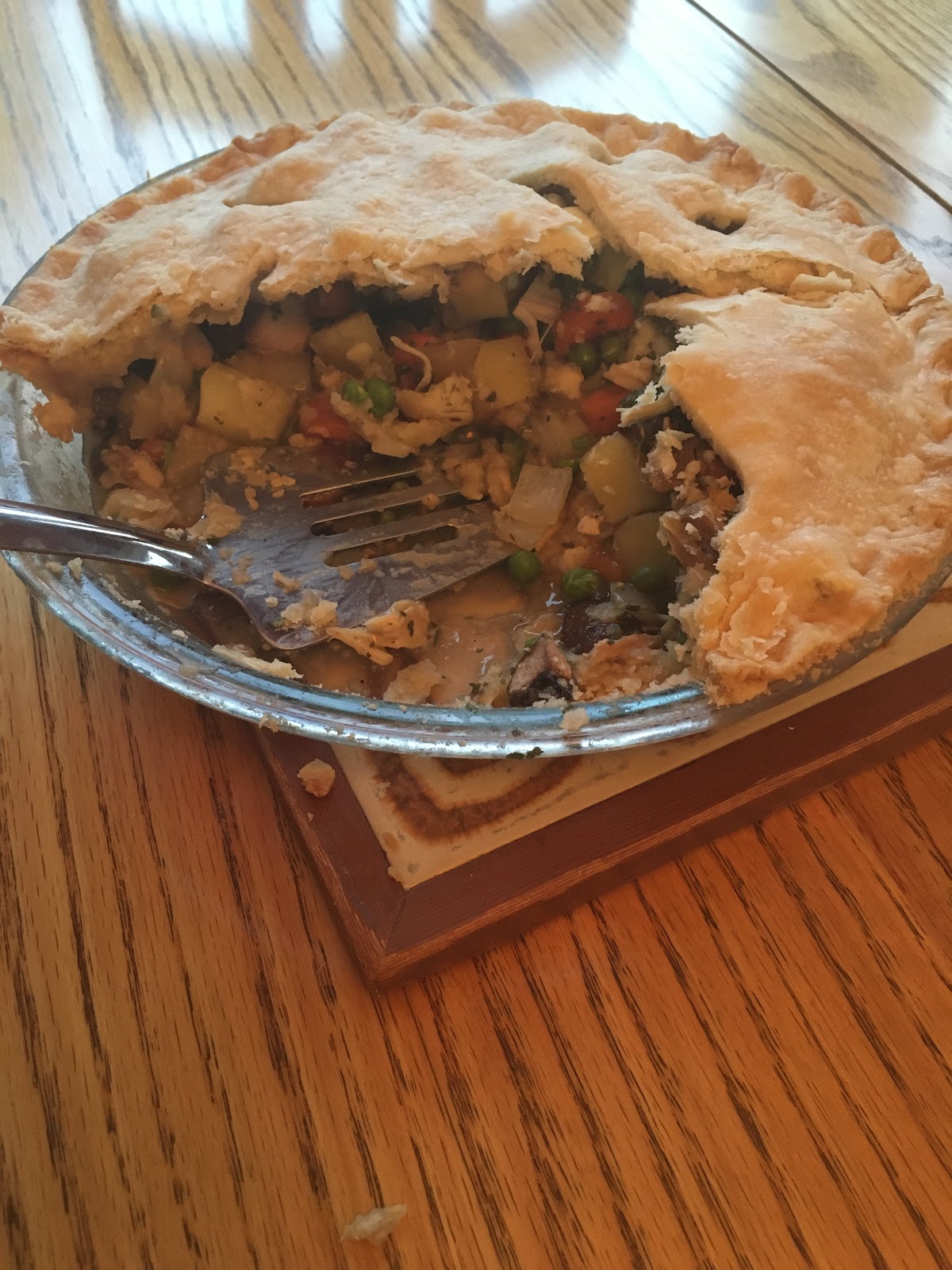
Turkey Pie
Two Berry Pies

I baked two mixed berry pies, one for us and one for my daughter's family. We did a pie drop-off the day before Easter. Perhaps we couldn't all spend the day together, but at least they had dessert for their Easter dinner. This pie has previously made an appearance here.

Of course we couldn't eat the whole turkey, so I froze much of the meat, and the bones for stock. This week, I used some of the frozen turkey meat to make a turkey pie. I still have lots left for soup.

Indian Curries

Last week, I also made a vegetarian chick pea and vegetable curry. The next day, we ate the rest of the vegetable curry along with some homemade chicken korma. A couple of years ago, my step-daughter gave me a great little cookbook, pictured below. I invested in some good Indian spices and learned to make my curries from scratch.
Curry Cookbook
Chicken Korma, Vegetable Curry, & Rice


Last Words

Rob is an appreciative diner, and therefore a delight to cook for. He cooks sometimes too. He likes to make pancake breakfasts for us on weekends.


Devil's Food Cake
Just in case you're not yet hungry, I've included a picture of a devil's food chocolate cake. I originally got the recipe from a community cookbook and have been making it for 55 years.

Hopefully, my desire to cook will still be with me when we're finally able to have guests for dinner again.


Thursday, May 23, 2019

So Where Have You Been, Dr Sock?

I haven't posted for so long that you might have thought I'd disappeared somewhere. I've hardly been keeping up on reading my favourite blogs, either.

Good Life, Good Food
Well actually, I've been right here. I made one quick trip to northern BC, but mostly I've just been here at home, living my life.

We've had some friends and family visiting over the past month.

My brother was down here for a visit in late April.We had a great time.

Trail at the Point
We showed him some of our favourite hiking places.

Also the beach, of course!


With My Bro


We also biked the Parksville to Coombs Rail Trail there and back, with a nice stop for lunch in Coombs at the famous Goats on the Roof. It was great to get out on the mountain bikes for the first time this spring. Since then, we've cycled the Rail Trail once more, and also the trails around Enos Lake.

Intrepid Cyclists
We had a visit from my son, who has just returned from a holiday in Barbados. We're looking forward to a visit from my daughter next week.

Our friend Cliff has been visiting too. Last week, we spent an afternoon out on Cliff's ranger tug cruising along beaches and around islands.

Ahoy Captain!
At the Marina
Livin' The Dream
Easter was a big hit with the grandkids. I can explain it in one word: chocolate!

Face Paint and... Chocolate!
My Booth at the Spring Showcase


The last weekend of April, my art group hosted a Spring Showcase. It was well attended and we had a number of guest artists join us this year. You can read more about it here.

The weekend after the art show, I attended a writers' conference. Several members of my writers' group went as well.

I've also been busy with volunteering activities. I volunteer a couple of times a month at my grandson's preschool. Our service group hosted a community Easter Egg Hunt. We also joined the Broombusters' initiative, and spent an afternoon cutting scotch broom around the community centre. Broom is an invasive plant in our area that suppresses native species, is toxic to other plants and animals, and creates a fire hazard. Invasive species are the second greatest cause of loss of species diversity around the world.

Rob Cutting Broom

During April, I spent three weeks participating in the Drawdown Eco-challenge. Participants' focus during the eco-challenge was to commit to making personal changes to reduce their individual impact on global warming. I chose two daily challenges: to eat two meatless meals a day, and to walk daily in nature. As well I completed several one-time challenges, including: creating a compost bin in my yard, mulching trees and shrubs, learning about electric vehicles, learning about heat pumps, and donating to purchase clean cook-stoves in developing countries. There were many options to choose from, including challenges that involved collaborating with community groups or communicating with local leaders to influence environmental policies.

The Drawdown organization eco-challenge that I participated in is not the only chance to get involved. There is a July challenge to go plastic-free. There are also a number of other groups doing great work to reduce global warming and to mitigate the effects of climate change, such as 350.org and Blue Dot. I plan to continue to educate myself and to make changes to reduce my carbon footprint. I have come to understand that the human race has reached a critical juncture and that we need to make sweeping changes now if we want to leave a liveable planet for our children and grandchildren.

I haven't been giving the garden the attention it deserves, but somehow it still manages to look beautiful. My potato, strawberry, and tomato plants are thriving, as are the pots of herbs. However, I can't seem to get the spinach to grow. Bunnies, perhaps?

Monday, April 1, 2019

It's Gardening Season!

It is almost two years ago since we travelled to Vancouver Island to look at real estate and ended up making an offer on this house that is now our home. One of the striking features of this place is that it has a large property and a beautiful garden. When we viewed it in April two years ago, the garden was in bloom and it looked glorious.

The Garden Last August

The previous owners were avid gardeners with a great sense of aesthetics. The entire backyard is a decorative garden with flowering trees and shrubs, rockeries, and a pond feature. It also has deer-proof fencing, which is an important consideration on Vancouver Island. There are lots of deer here, and they eat almost everything.

Having now spent nearly two years here, we have discovered that the garden looks beautiful in every season.

I have always enjoyed gardening, but my expertise is more in the area of organic fruit and vegetable gardens. I have also grown small flower gardens, with both perennials and annuals. But I am not very knowledgeable about caring for our current type of garden. As well, I wondered where I might be able to grow some vegetables and herbs.

The first year, we decided to to not touch anything in the garden. We waited and watched to see how it changed with the seasons. We weeded, watered, and did a little pruning.

Last summer, we took out a few shrubs that had died in the previous summer's drought conditions. We moved some shrubs that were too crowded to different locations. We added drip irrigation hoses, and sea soil, especially to the rhododendrons. We pruned more confidently. We weeded and cultivated, and did a little mulching.

I planted pots of herbs and tomatoes on the deck. I tucked some strawberry plants, kale, carrots, and beans in among the shrubs. They all thrived -- except for the beans, which the bunnies ate. Vancouver Island is overrun with rabbits as well as deer.

This year, I decided that one way or another, I was going to build a vegetable bed. I really like to grow at least a little of my own food. It is very pleasing to walk out the door and pick something for supper. Home grown food is the freshest possible food. Also, because I use organic growing methods, I know that there will be no noxious chemicals in the food or soil.

The problem is, there really is no sensible place to put a garden. In the front, there is a long sloping lawn shaded by huge evergreen trees. There is a small side yard that is flat enough, but it is shaded on every side and never sees the sun. And in the mostly flat, sunny backyard, every square inch is planted already.

I did not want to detract from the aesthetics of the beautiful garden.

I finally decided to build a small vegetable bed in the corner of the fence by the gate. It is not the sunniest location, but I think it will be okay. It is away from the the long roots of the evergreen trees, and it was not a very pretty part of the original garden design.

So, this week, Rob removed a small decorative pine tree from that location. Behind it, he took out some kind of prickly shrub with bright yellow sap. I cleaned up the area and turned over the soil and added 75 liters of black garden soil. Today I planted it.

So now I have a small vegetable plot, about five feet by seven feet.  It looks fine to my eyes.

Watering the New Veggie Garden (Left of the Daffodils)

The strawberry patch that I planted last year looks like it will thrive. The kale plants made it through the winter and have put out new leaves. They now look like small bushes, but the leaves are quite edible, so I'll leave them in place for now.

Today, I also planted a magnolia tree. I love the beautiful tulip shaped blossoms of magnolia trees. But much of my life I have lived in climates that are too cold for magnolias. In our garden, there was a perfect space for the tree near a bench in the corner of the yard. A shrub, a kind of decorative pine that previously had been in that space, had not survived the hot dry summer. So now we have a magnolia tree!

I dug a Big Hole
Planting the Magnolia Tree

The next challenge is to create a compost pile or bin. There's more to come on that topic another day.


Sunday, March 17, 2019

A Plan to Reverse Global Warming

A Path Through the Forest

What Can I Do?

In a recent blog post, I wrote about my sense of helplessness and personal paralysis as I considered what I can do to help address global warming and climate change. The problem is huge and multi-faceted, and change on a global scale is urgently needed for humanity's survival (or, perhaps more accurately, the survival of human civilizations).

As a single individual, I cannot solve climate change. But I can do my small part to make a difference, to the best of my ability.

So where should I put my efforts? What actions would have the biggest impact, match my particular knowledge and skill set, and be within the scope of what I can actually accomplish?

Although I have been slowly educating myself about the challenge of global warming facing us as a species, I decided that I needed to do some reading about not just the challenge facing us, but about possible solutions.

Drawdown

So I ordered the following book from the library: Drawdown: The Most Comprehensive Plan Ever Proposed to Reverse Global Warming. It arrived a couple of days ago. This book, edited by Paul Hawken and published in 2017, was a New York Times best seller in 2018. There also is a website that is even more extensive and up-to-date than the book at www.drawdown.org.

So what is "drawdown?" The website defines it this way: "Drawdown is that point in time when the concentration of greenhouse gases in the atmosphere begins to decline on a year-to-year basis." Once greenhouse gases begin to decline, the warming of the planet will begin to reverse.

The book sets out 100 global strategies, which, if we implement them all by 2050, will enable us to reverse global warming. The strategies are in the following categories: Energy, Food, Women and Girls, Buildings and Cities, Land Use, Transport, Materials, and Coming Attractions (promising future technologies and solutions).

All of the approaches (except the last category which is more speculative) already exist and have been rigorously researched and modeled by a team of more than 200 scientists and other specialists from around the globe. Each one is ranked in terms of how many gigatons of carbon dioxide (and other greenhouse gases) will be reduced by 2050 using that solution, an estimate of how much it will cost to implement, and what the net savings will be. By reduced, I mean either CO2 that will be removed from the atmosphere, or CO2 that would be added if we continue on our current course but that we will avoid adding if we use this solution.

In the book, they have adopted a conservative bias -- that is, left room for error if the proposed solution is not quite as effective or adopted as readily as the scientific evidence suggests is plausible. 

Upon receiving the book, I looked at the Table of Contents and how the book was organized. I read the brief Forward that described the purpose of the book and the assumptions they worked within. Then I flipped straight to the back of the book and read the table of statistics (yes, I'm a nerd).

The numbers show that, by 2050, in the Plausible Scenario (the outcome that we should be able to achieve with good effort), we will be able to reduce 1,051 gigatons of carbon dioxide. That will not get us to drawdown or reversal of global warming. In order to reach drawdown, we will need to reduce carbon dioxide by 1442.3 gigatons. This is the Drawdown Scenario, and they describe how it can be achieved. They also show an Optimum Scenario -- one where we are able reduce carbon dioxide by 1612.9 gigatons.

I also skimmed through the brief bios of the 200 scientists and other experts from around the world who contributed to this research and plan.

My Initial Response

 My first thoughts on getting this far with the book were:
  • a huge sense of relief that so many really smart people with appropriate backgrounds are working on developing solutions and a plan
  • surprise at the wide range of human activities that are currently contributing to the problem, and the practical solutions in each area. 
  • a dawning realization that we have to work on the problem of global warming on many fronts simultaneously -- electric cars, solar power, and wind turbines are not by themselves a solution. They are only part of the solution. 
  • surprise to see that the data shows that the net savings of implementing "greener" solutions exceeds the costs. That is, green solutions are in most cases less expensive than what we are currently doing. 
 I also appreciated that the book is very engaging and interesting to read, not dry and technical as so many reports about climate change and policy frameworks tend to be. It is beautifully illustrated with photos of different landscapes and cultures around the world.

So I dived into the meat of the book.

Drawdown, Open to the Section on Food

Food

I decided to start with the section on food, because I am very interested in food.

I was surprised to learn that a broad-based switch to eating a plant-rich diet is one of the most effective ways of reducing greenhouse gases -- ranked 4th of the 100 solutions. They point out that our "Western diet comes with a steep climate price tag," noting that raising livestock accounts for 15 to 50 percent of current greenhouse gases emitted each year. A large proportion of this is because of the deforestation that takes place in order to create grazing areas for cattle, in particular.

They report that the average Canadian and American eats more than 90 grams of protein each day, much of it from meat and animal products. An adult's daily protein requirement is 50 grams and all or most of it can be obtained from plant-based foods.

They recommend reducing meat consumption and avoiding overeating by restricting calorie intake to 2500 calories per day, on average. Citing Thich Nhat Hanh, a Zen master, they say, "making the transition to a plant-based diet may well be the most effective way an individual can stop climate change."

As I have written here before, I eat a healthy well-rounded diet that includes meat. But this book convinces me that reducing my meat consumption is something immediate and positive with respect to climate change that I as an individual can do.

Another astonishing source of CO2 in the atmosphere is from food wastage. More than a third of the food we grow or raise every year in the world is thrown away, primarily in high-income economies. Yet around the world people are going hungry.

The wasted food contributes the equivalent of 4.4 gigatons of carbon dioxide every year. If we used the food instead of throwing it away, globally we could reduce the need to clear more land to grow food, which causes deforestation. Reversing food wastage is ranked third of the 100 solutions in terms of carbon dioxide reduction. If by 2050 we only threw away half as much food as we do presently, we could reduce CO2 by 70.5 gigatons, they say.

Some of the other topics I have read about include farmland restoration (#23), clean cookstoves (#21), multistrata agroforestry (which means planting crops under trees) (#28), improved rice cultivation (#24), growing rice using the system of rice intensification (#53), and silvoculture (grazing livestock in forests) (#9).

There are still several other strategies that involve food and agriculture that I have yet to read about. It is interesting to discover that so much of our greenhouse gases come from our systems for raising and handling food.

Michael Pollan's advice: Plant a food garden in your yard or community. Because of our industrialized approach to agriculture, every calorie of food produced requires 10 calories of fossil fuels to produce it. Therefore, he says, growing your own food is one of the most powerful things you can do. 
 
Why It Matters

To me, the reason that it is imperative to take action is that the well-being of future generations rests on the choices we make right now. Every month that we delay, we pump more greenhouse gases and particulate into the atmosphere. Some of them, like carbon dioxide, remain in the air for decades or even centuries. Others, like black carbon, only stay in the air for eight to ten days, but hugely accelerate the warming effect when they are present.

Taking action now means that our grandchildren and our loved ones' grandchildren will inherit a beautiful world in which they can thrive. The alternative, if we do not take action, is too horrible to contemplate.

I'll leave you with some photos of me on a recent hike with my son and daughter.

Monday, November 19, 2018

Food, Beautiful Food

I love food. One of the best things about travelling is having the opportunity to sample new restaurants and different cuisines.

As you know, Rob and I have just returned from travelling in Portugal. We started in Lisbon, made our way north to Porto via Sintra, did a driving loop to visit three northern pousadas, and then returned to Lisbon.

While we were in Lisbon, we we went down to the Bairro Alto, the old downtown core of Lisbon, for dinner the first few nights. This is a picturesque area of narrow cobblestone streets, traditional architecture, clubs, Portuguese restaurants, and fado singers. The area is filled with tourists.

The restaurants here feature traditional Portuguese cooking, which I love. Rather than elaborately plated fine dining, the food is hearty in a "farm food" or "fisherman's food" kind of way, and menu items may be served "family style." This means that you order à la carte, and share with the table (the servings are large!). The photo below shows a rabbit pie that I ordered one night. It was fabulous!

Rabbit Pie
As a sea-faring nation, Portuguese restaurants offer many kinds of fish and other seafood on their menus, which made me happy. I ordered fish more often than not, whereas Rob indulged in all manner of meaty dishes. One of the most delicious dishes we shared while in Lisbon was an octopus salad (which I forgot to take a picture of, I was so intent on eating it).

I can't write about traditional Portuguese dinners without mentioning the appetizers that are laid out in front of you when you first sit down. They always set out olives, bread, and soft cheese, along with a variety of other tasty items. They only charge you for the ones you choose to eat, and you can ask them to take the rest away. Our Portuguese friends tell us that experienced diners wave away the couvers (I am not sure about the spelling of that), but Rob and I discovered so many interesting dishes that we didn't always send them away. We ALWAYS  kept the olives, as Portuguese olives are so much better than the ones you can get in North America. And so is the wine, but I am not going to write about the wine here, although we sampled quite a lot of it.

On this visit, we also spent quite a lot of time exploring the newer part of the city around the Parque das Nações area. This is the huge area where the 1998 Expo was held. It has all been developed into an area of public parks and public buildings, restaurants, museums, and so on, and also there is a huge shopping mall there. It was interesting to experience modern Lisbon culture and more contemporary cuisine in this area.

Although our hotel was near the airport, it was easy to get anywhere in the city via the Metro. Each day, we bought a daily Metro pass for 6,30 Euros, and with that we could ride anywhere on the Metro trains, and transfer to buses as well.

All of the pousadas and other hotels that we stayed in (except the little pension in Sintra) came with a full breakfast buffet. The three pousadas all offered spectacularly good breakfasts, and so did the Lisbon Marriott hotel, where we stayed on our last night in Portugal.

The pastries in Portugal are divine, and there were always many freshly baked pastries on offer for breakfast, as well as in every coffee shop. There are many regional specialties (which we did our best to sample), but I think my favourite is Pastel de Nata, an egg tart pastry that is considered to be the national pastry.

The photo below shows the breakfast table at the Pousada Viana do Castelo. Not only was the breakfast really good, but also it was a very beautiful dining room. The views out the windows over the city and ocean also were great, as this hotel is located on top of a mountain.

A Beautiful Breakfast Buffet in a Beautiful Room
The food was also good at the Pousada de Canicada-Geres. In particular, I enjoyed a really tasty gazpacho as my first course. Rob ate a cabbage and sausage soup, which he liked.

Possibly the Best Gazpacho Ever
Our dinner in the Pousada Mosteiro de Guimaraes was perhaps the most "haute cuisine" meal that we enjoyed. The first photo below shows us sitting at our table, and the next one zooms in on my chicken dish, which was as delicious as it was beautiful.

Dinner in the Historic Monastery in Guimaraes 
Beautifully Presented and It Tasted Delicious
I haven't mentioned the dessert buffet yet. Each pousada also offered a table groaning with the dessert selections, many being specialties of the area. How could we have room for dessert after appetizers, soup, and an entrée? Somehow, we managed.

If you are thinking of going to Portugal, one thing you should be aware of is that people dine late there (by North American standards). Most restaurants do not open for dinner until 7 pm, and more fashionable diners tend to eat even later than that. If you get hungry in the late afternoon or early evening, it can be hard to find any place open even for a snack.

On our first trip to Lisbon in 2011, we stayed at the Lisbon Marriott. We both remembered the breakfast buffets there fondly, and when we returned there on this trip, it did not disappoint us.

Kitchen at the Lisbon Marriott
We also had good dining experiences in Sintra and Porto. And I confess that I have dozens more photos of food that I have not included here. It is not only millennials who like to take pictures of their food ;-)

In Porto, we dined at outdoor restaurants along the quay each night. It was lovely to look out across the river at the twinkling lights, sipping wine and enjoying our dinners. I will leave you with a final photo of a dessert we shared in Porto. It looked even prettier before we started to eat it!

Orange Cake With Tangerine Ice Cream

Sunday, October 14, 2018

Art, Family, and Food onThanksgiving Weekend

Last weekend was Thanksgiving weekend in Canada. Thanksgiving, for me, has always centered around family coming together from wherever we are and enjoying good food. Now that I have retired and moved back to BC, it is much easier to enjoy holiday celebrations together. I live near my oldest daughter and her family, and my two other (grownup) children are just a ferry ride away. Rob’s two kids and that set of grandchildren live farther away, and we are planning to travel to spend Christmas with them. 

But, this Thanksgiving was a little different from past years. The studio art tour group that I belong to hosts three events a year — a Spring Showcase, a Thanksgiving Studio Tour, and a Christmas Crawl (which is also a studio tour). I participated in the Spring Showcase, and wrote about it here. The Thanksgiving Tour includes all three days of the long weekend. 

For the tour events, artists open their studio/galleries to the public. People drive from studio to studio to view and purchase art, including paintings, pottery, handmade glass, wood carvings, jewellery, fabric art, and soap. Twenty studios were open for our Thanksgiving Tour.

This is the first time I have been part of a tour. It required lots of preparation.


This photo above shows my new sandwich board sign. There are also photos below showing the sign I now have in front of my studio. My daughter, the net artist designed the logo, and Rob built the cedar signpost and sandwich board.


I had lots of visitors to my studio over the three days, and even started a new painting.
Read more about Nanoose Bay Thanksgiving Studio Tour here.

My younger daughter, her friend, and my son came over on the ferry for the long weekend. Because of the tour, I did not have time to cook a big Thanksgiving Dinner. Instead, my daughter had the whole family over on Thanksgiving. She cooked an amazing feast! We also went out one night to a local English style pub and had a great dinner there, followed by some goofing around.


The weather has turned to Fall, and the leaves are brilliant colours.

I am grateful for my family, good times together, the chance to make art, and the beautiful place that I live.