Showing posts with label memoir. Show all posts

Monday, January 25, 2021

Author Interview: Liesbet Collaert

Liesbet with Kali and Darwin
  Today I am happy to bring you an interview with the writer, Liesbet Collaert. Liesbet has recently published her travel memoir, Plunge. It is a fascinating account of ten years that she spent living on a sailboat and exploring parts of the world that most of us only dream of. 


Jude: 


You have spent most of your adult life travelling throughout the world, and you describe yourself as a nomad. In what ways is your nomadic life different from a typical western lifestyle?


Liesbet: 


The beauty of a typical western lifestyle, in my opinion, is the stability, comfort, and familiarity it offers. You know what to expect, you have neighbors/friends/family/ colleagues around, you easily find products in your grocery store, you have favorite restaurants, trails, outings, hobbies, and your planned activities usually work out.


Life on the road, or the water, as a nomad is insecure, unfamiliar, and rather challenging because of these reasons and others. Yet, the adventure and freedom make it worthwhile. My husband and I love that novel feeling of each new place, have learned to be flexible, and keep our expectations low or non-existent. We are self-contained, fix issues ourselves as much as possible, and don’t rely on people. We figure things out as they come and enjoy discovering unique locations, cultures, foods, …


Another big difference are the amenities everyone takes for granted: running water, unlimited electricity, reliable internet, a washer and a dryer. Each time I stay in a house of relatives, I embrace my hot, pressurized shower, the space in my room (I can walk more than one step before I bump into something), the fact that my computer can stay plugged in, and the real bed. If there’s a comfortable couch, I might never leave! 😊

 Jude: 

Your memoir, Plunge: One Woman’s Pursuit of a Life Less Ordinary, spans about a decade. Why did you focus your memoir on those ten years in particular?

Liesbet: 

That’s a great question, Jude! I knew so little about writing books that the first time I ever considered this project, I didn’t even know that my kind of story was called a memoir. One of the first things I learned about that genre is that it covers a “slice” of your life. I wanted that particular “slice” to have a definite beginning and end. It seemed most intuitive to start with how I met my now husband, Mark, a life-changing, somewhat crazy occurrence that led to a new adventure. And, I finish the memoir when that adventure ended. Coincidentally, this period encapsulated ten years: my tumultuous thirties. In the epilogue, I leave the door open to the next adventure…


Jude: 


Briefly, what is your book about?


Liesbet:  


Plunge encompasses the ups and downs of a life less ordinary in the tropics. The story is about a 30-year-old nomad who seeks adventure and freedom at sea, but finds herself at odds with love, work, immigration, weather, and health as she navigates the world and her relationship.


The book is written in a unique voice and seamlessly intertwines travelogue and introspective, so the reader is immersed into each new scene, physically as well as psychologically. The story takes place in the present tense to accommodate this effect and incorporates foreshadowing, flashbacks, and cliff hangers, like a novel.


Jude: 


In your book, you present an account of the nitty-gritty experiences of life aboard a sailboat, and well as a close-up view of your romantic relationship. Can you talk about the challenges of writing about such personal material?


Liesbet: 


Most people who know me (including you, Jude) are aware of my straightforwardness and urge to be myself. My memoir had to be a fair representation of this. The two major factors that define my personality and feelings are my lifestyle and my relationship. But, how do you pull the reader into these situations? How do you make them understand what you go through?


This is only possible by allowing them inside your head and by being totally (some call it “brutally”) honest. Therefore, I touch on the good and the bad in my relationship; the strengths and the flaws in my personality. While lots of memoir authors struggle to put those moments and factions down, it came easy to me. Maybe because I hope that – just like in real life – people will take me the way I am; true to myself and others, while sometimes being a bitch.


I also mention discriminating elements about my spouse. He knows this; he was the first one to read my book. He also knows about my desire to tell the truth. His reaction when others ask him about those parts in Plunge: “It all happened. I was a jerk sometimes.” While it might put some people off, this “raw honesty,” most readers have complimented me about my voice and the themes touched upon and, whether they admit it or not, they can relate to many of the situations.


Liesbet and Mark on their Catamaran
   

Jude: 


As a regular reader of your blog, Roaming About, I recall posts in which you mentioned the frustrations of combining a writer’s life with a nomadic lifestyle. Please describe some of the issues you faced on the boat, and now while travelling around in your camper van.


Liesbet: 


These issues pretty much boil down to those differences between a nomadic lifestyle and a typical western one, described above. While we have solar panels to provide electricity to my computer and we can usually go about five to six days on our fresh water tank, I am never as productive as I would be in a house or a room with unlimited electricity, reliable internet, and a desk.


Problems often occur, whether they are weather-, dog-, errand-, or camper-related. Distraction abounds. And there is the fact that I live together with a husband and 60-pound furry creature in an 80-square foot (7.5 m2) metal box on wheels. Even when we decide to “sit still” for a while so I can write, edit, or promote, I struggle with not being available to my family members and feel guilty about hogging our one table, stressing out, and not partaking in walks. Finding a balance between my work and our “leisurely” lifestyle is a goal for 2021.


Jude: 


What did you find were some of the pros and cons of self-publishing?


Liesbet: 


Self-publishing is hard work! You need to be determined, patient, focused, and dedicated to make it happen. The process is time consuming and frustrating, especially when you are new to all the different steps (and there are many). You also need to pay for professionals upfront, so it’s more expensive than going the traditional route. And, I still feel there is less prestige than when “having a publisher.”


However, there are many pros. The first one: pulling it off quickly. Sure, I focused 100% on getting Plunge published this year, but the actual time involvement from the moment I received my final cover design to holding a proof copy in my hands was two months. My husband was a big help and we did all this from the road. Another positive of being self-published is that you hold all the strings. Decisions are yours, you can make corrections easily, offer discounts, work hard on promotion – or not, and it’s a huge accomplishment!


Jude: 


I imagine that you plunged into learning a lot of new skills when you went the self-publishing route. Can you share one specific example of something you learned?


Liesbet: 


The formatting process! Who knew there were so many decisions to make? Font style and size, spacing between the lines and towards the edges, placement of the page numbers (top, bottom, left, right, middle), kind of section breaks, order of the photos, where to hyphenate words at the end of the line, how about the chapter titles and table of content?


Jude: 


One reason I love reading memoirs is the chance to absorb an inside perspective about another person’s life. Can you share an insight with readers that came to you about yourself, your life choices, or your relationship, as you reflected on this period of your life in the memoir?


Liesbet: 


Yes. Because I wrote Plunge in the present tense, I wanted to mentally transport myself back to my thirties. In doing so, I realized how spoiled I had been in my twenties – I basically did whatever I wanted – and how, during the course of this story, I “grew up.” My experiences aboard our 35ft catamaran Irie made me realize I don’t always get what I want, that there are two people in a relationship, and that adventure comes in many different forms.


Jude: 


Do you have a new writing project on the horizon?


Liesbet: 


I have many ideas, but have not started anything new yet.


Jude: 


Is there anything else you’d like to add?


Liesbet: 


I want to thank you for your thoughtful and insightful questions, Jude, and for featuring me here today. I hope your readers will get a chance to read Plunge and that it entertains, inspires, or affects them.


Liesbet and Jude in 2018

I'm pleased to feature this author interview here on Dr Sock Writes Here today. I initially met Liesbet through blogging, but in 2018 I had a chance to meet her and Mark in person when they came to Vancouver Island and stayed with us.


I greatly enjoyed reading Liesbet's book. It gave me an inside scoop on some of the joys and challenges of the sailing lifestyle, and reminded me of the many of the important life decisions One makes in the decade of their thirties.  


To read more about Liesbet’s adventures and her writing life or to purchase the book, click here:


For more info about Plunge:

https://www.roamingabout.com/about-plunge/


To buy on Amazon: www.amzn.com/B08NHP3NHC


Liesbet’s alternative lifestyle blog: www.roamingabout.com


Liesbet’s sailing blog (2007 – 2015): www.itsirie.com


Liesbet’s Amazon author page: https://www.amazon.com/Liesbet-Collaert/e/B073C9F8TW


Monday, November 23, 2020

The Cost of Responsibility

Many years ago, early in my career, I had the opportunity to travel to Quebec City to give a presentation at a conference. I was terrifically excited. I'd never travelled to Quebec City, nor, for that matter, had I visited any parts of Canada east of Saskatchewan. 

The conference was in an area of rehabilitation in which I was developing some unique expertise. I applied to my employer for funding, and they agreed to pay for the the plane ticket, hotel room, registration, and my meals during the weekend of the conference. It was a very good career opportunity. The icing on the cake was that one of my best friends had also had a paper accepted at the same conference, and was planning to attend too. Fun!

I was a new mom at the time, and our baby was about eight months old. The dilemma I faced was how to attend the conference and also look after my daughter. My husband and I decided that we'd go to Quebec City as a family. That way, he could care for her while I was in the conference sessions. 

We also decided we'd both take some vacation time off and stay for a few extra days after the conference. My husband, of course, paid for his own plane ticket and expenses, and the baby flew for free. We rented a B&B for the extra days after the conference. 

The morning that we were to leave to fly to Quebec, my daughter woke up with a red rash on her face. She'd never had anything similar. However, she seemed happy and her behaviour was normal, and she did not have a fever. The spots seemed to be fading a bit, so we made our way to the airport for our flight. 

But I was consumed with anxiety. What if she had something contagious, like measles? Perhaps we'd be putting others on the flight at risk, crammed together in a row of seats for the hours it would take to fly from Vancouver to Quebec City. 

So, after being cleared for our flight when we went through inspection, I pointed out the rash and asked whether they could change our seating assignment so we weren't seated right next to anyone else.

Well, you've never seen airline officials move so fast. They whisked us out of the inspection area and put us into a holding room while they contacted their supervisor. The verdict was that we couldn't board the flight, or any flight, until we had medical clearance to fly. 

As we made our way back home, I felt like a fool. Why had I opened my big mouth? The airport personnel hadn't even noticed the rash until I'd pointed it out. The baby was clearly fine. She was gurgling happily in her car seat.  

It felt like a crisis. At that point in my career, it was inconceivable to not show up to deliver a presentation that I'd promised to give, that was already printed in the program, and that I'd spent many hours preparing. My employer had paid for the conference and flight. Would they have to forfeit the money? Would I have to pay them back? Would we forfeit the cost of my husband's flight and the deposit for the B&B? My husband had cancelled his clients' appointments for the week. We would "waste" precious vacation days. 

After some frantic phone calls, we were able to get in to see a physician that same day. The physician examined my daughter and declared that the rash was nothing serious, perhaps heat rash or a mild food sensitivity. She filled out a medical authorization form and the airline put us on a flight the next morning, by which time the rash had totally disappeared. 

With friend & daughter; Chateau Frontenac
 We arrived in time for me to attend the opening reception of the conference. The entire conference was excellent, and we had a wonderful time in Quebec City. We happened to be there at the time of lobster fest so we ate a great deal of yummy lobster. 

Strolling Around Quebec City
 For a long time, I thought the lessons that I had learned from this experience were:

  • Don't create problems for yourself by pointing out minor issues that the authorities otherwise wouldn't notice
  • Something that seems like a huge crisis in the moment often turns out to be a minor bump in the road
  • Always leave some extra time before and after a scheduled event when travelling, in case of unexpected delays.

But through our collective experiences during this worldwide epidemic that has been dragging on and on, I suddenly remembered this long-ago experience and realized that I learned something else, too. 

Because what if my daughter's rash had NOT been a temporary, minor occurrence? What if it had been been measles or chickenpox or some other very contagious disease, and by going on the flight we exposed someone else -- perhaps an expectant mother or an elderly person -- to an illness that could cause disability or death? My desire to attend a conference and to tour Quebec City would have seemed like trivial reasons to have put others at such grievous risk. 

There can be costs for making the responsible choice. 

But sometimes the costs of making an irresponsible choice can be ever so much higher. 

Saturday, May 2, 2020

Cooking My Way Through the Pandemic

First, a warning. Don't read this blog post right now if you're feeling hungry. 

Last Piece of Salmon (Caught by Rob)
Chicken Stuffed with Cheese & Sun-dried Tomato

Cooking and Me

I have always enjoyed cooking. It all started with baking. Somewhere in the family photo album, there's a picture of me around age 6 or 7 proudly displaying a cake I'd made in my Easy Bake Oven, a toy oven that was popular in the 1960's. My mom baked a lot, and she taught me to make cookies, cakes, and squares from scratch long before I took my one and only home economics class in Grade eight.

I helped with the cooking as a teenager, When I moved into my first apartment at age 20 after enduring three years of horrible university residence food, I embraced cooking and home meal planning with zest. I took a natural foods cooking course. "Natural foods" is what we called vegetarian cooking back in the 1970's, and the emphasis was on organic unrefined whole foods. I joined a food coop. I learned to make granola and bread. I went on to learn to preserve foods, and made a lot of jam, jelly, pickles, and canned fruit over the years.


Mom's Pie Crust Recipe in her Handwriting
My Cookbooks


I've collected a bookshelf full of cookbooks. As well, I have two thick folders of recipes that I've clipped out of newspapers, been given by friends, copied out by hand from somewhere, or developed myself and written down.

Most of the time these days, I invent meals as I cook them, without following a recipe. When I do use a recipe, I usually refer to one of my old standbys. Or, I look up recipes on the Internet and adapt them.

This past year, I lost enthusiasm for cooking. I don't know why, but I became bored with it. Except for a brief flurry of cooking around Christmas, when my son and two of my brothers came to stay with us for a few days, and when I volunteered to plan a community Christmas dinner for 60 people and cook it with the help of my service club, our meals became rather ho-hum.

The pandemic changed all that. Over the past six weeks I have been cooking and creating all manner of things in the kitchen. The photos above of the baked salmon and of the stuffed chicken breasts are two examples of my cooking efforts.

Turkey For Two

When Easter came along this year, I felt sad. Usually we have a big family dinner. We all get together and visit and feast. Our service club hosts an Easter Egg Hunt for the community, which my grandsons love to participate in. But, as we were sheltering in place, we couldn't be with our family to follow our usual tradition.

I decided to make turkey for our Easter dinner anyways, just for the two of us. I purchased the smallest turkey I could find and stuffed it and roasted it.

Roast Turkey
When you look at the photo, don't be fooled by the bare drumsticks. It might have been the juiciest, most delicious turkey I've ever made.

Turkey Dinner for Two


Turkey Dinner Close-up
Rob Adds Gravy
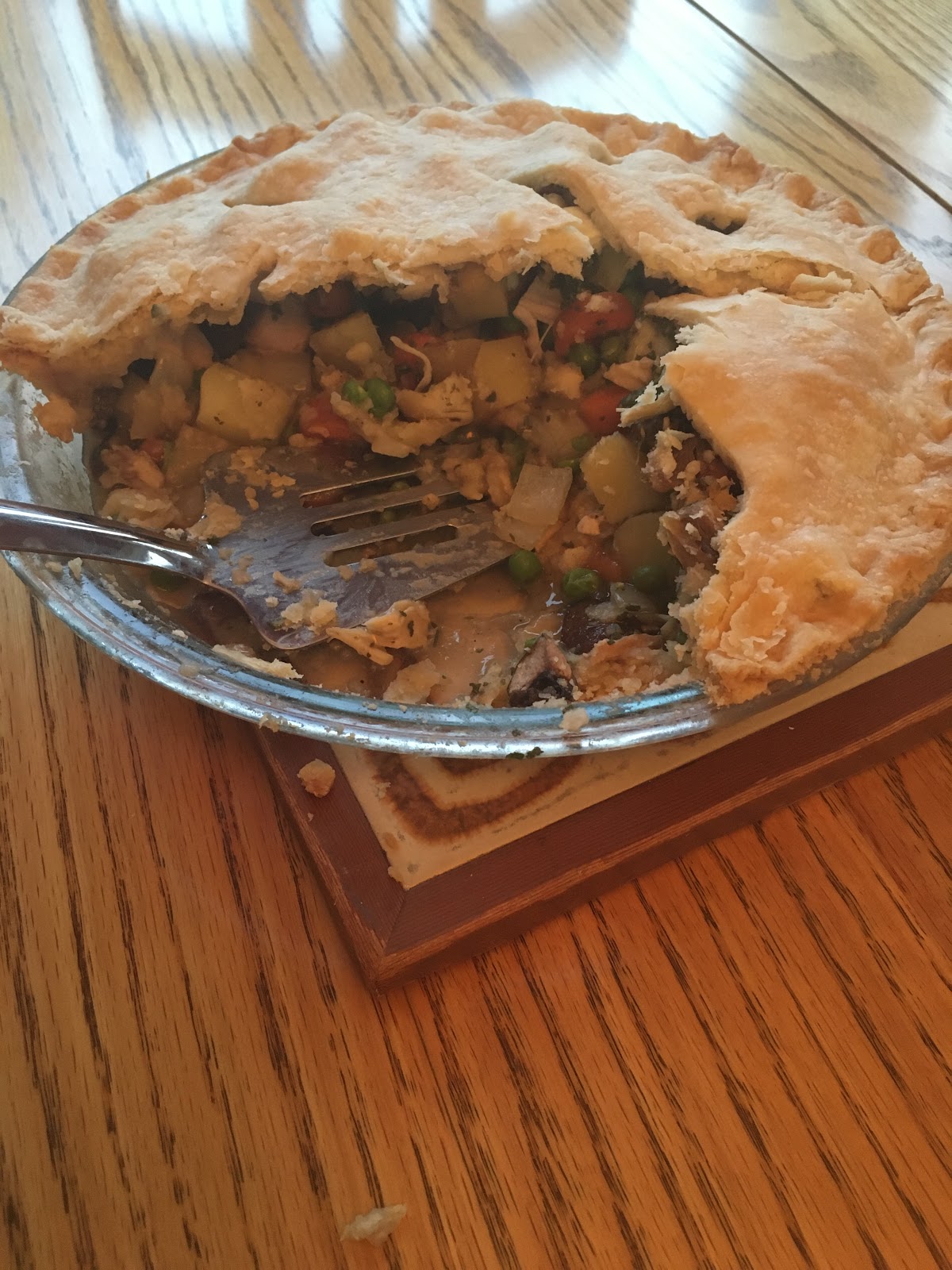
Turkey Pie
Two Berry Pies

I baked two mixed berry pies, one for us and one for my daughter's family. We did a pie drop-off the day before Easter. Perhaps we couldn't all spend the day together, but at least they had dessert for their Easter dinner. This pie has previously made an appearance here.

Of course we couldn't eat the whole turkey, so I froze much of the meat, and the bones for stock. This week, I used some of the frozen turkey meat to make a turkey pie. I still have lots left for soup.

Indian Curries

Last week, I also made a vegetarian chick pea and vegetable curry. The next day, we ate the rest of the vegetable curry along with some homemade chicken korma. A couple of years ago, my step-daughter gave me a great little cookbook, pictured below. I invested in some good Indian spices and learned to make my curries from scratch.
Curry Cookbook
Chicken Korma, Vegetable Curry, & Rice


Last Words

Rob is an appreciative diner, and therefore a delight to cook for. He cooks sometimes too. He likes to make pancake breakfasts for us on weekends.


Devil's Food Cake
Just in case you're not yet hungry, I've included a picture of a devil's food chocolate cake. I originally got the recipe from a community cookbook and have been making it for 55 years.

Hopefully, my desire to cook will still be with me when we're finally able to have guests for dinner again.


Wednesday, September 26, 2018

The Last Good-Bye


My Mom died this summer.

She had been in poor health for a long time. She had a couple of close calls last winter, and a rough spring. But she bounced back this summer. She gained back a few pounds. She resumed her busy social life and many activities with new vigour. We stopped worrying quite so much.

And then one day on a sunny morning in August, Mom went downtown for a hair appointment. She was chatting with people. Suddenly, she gasped, collapsed, and stopped breathing. That was it. The end. Neither CPR, nor anything the paramedics did could bring her back.

It took me by surprise. It took us all by surprise. We were not ready to let her go.

Mom with her Youngest Grandchild

Mom and Me in 2014

I went back to my hometown to visit Mom earlier in the summer. I stayed with her in her spare bedroom, and we spent a lovely week together. I went with her to have coffee with her coffee buddies, and to lunch at the seniors' centre, followed by an afternoon of playing cribbage. I accompanied her as she purchased flowers and we went up to the hospital so she could give bouquets of flowers to patients who needed something to brighten their day. She used to do this every week.

We had some lovely dinners at my brother and sister-in-law's place, cooked at home some nights, and went to the Legion for beer and burgers on Friday. Mom's two youngest granddaughters came for a visit on Saturday afternoon, and we all went over to the playground across the street. Mom and I also did several drives out into the country to all of Mom's favourite places. We even did a short hike to the fossil beds. 

Mom and Granddaughters Returning From the Playground, July 2018

At her initiative, we went to tour the two seniors' residences in the community. Mom wanted me to see the places so I could see for myself that she was not at all ready for that type of living arrangement. She talked about her plan for how she would manage to get out and around this winter once the snow became deep. (She did not drive, but used a scooter for mobility. However, the previous winter, there had been some weeks that the snow had been too deep for the scooter.)

In the late afternoon of July 25, I gave my Mom a hug, jumped into the little white rental car, waved good-bye to Mom who was standing at her window waving, and drove away. That was the last time that I got to hug my Mom good-bye.

I was planning to visit again soon, in August. Rob and I were going to drive up north and arrive in time for the Fall Fair. We planned to celebrate my mom's 85th birthday with her on August 31. But just days before we were about to leave on the trip, my brother phoned with the news of her passing. On August 31, instead of celebrating my mom's birthday, we held a Celebration of Life service. 

Her one surviving sister, and every one of her children, grandchildren, and great grandchildren came to the service. It was the first time in I don't know how many years that all of the family has come together.

Dad, Mom, Me, and My Baby Brother

I flew up the day after Mom passed away and stayed at her place in the same spare bedroom in which I had stayed just three weeks earlier. It felt peaceful being there at Mom's place, surrounded by her stuff, remembering her. It gave me a chance to grieve. As well, I spent lots of time with my brothers and other family who live in the area, and we supported each other, and made the arrangements together.

At my age, I now have had quite a few experiences with death. But there is nothing like losing your mother. It is so stark and irreversible. I am now the oldest generation left in this branch of the family tree.

I spoke at the service. I said that I can always come home to Mom because I have her in my heart.

Tuesday, February 6, 2018

Restrictive Diets

I love food. I come from a family that loves food. I also enjoy cooking. Some of my happiest memories are of family dinners, or dinners with a group of friends -- everyone gathered around the table eating a feast that is the culmination of a day in the kitchen, laughing, talking, and drinking wine.

Holiday Feast

I am one of those nerdy people that takes photos of my food at a nice restaurant.

Airport Fare

Even if it is just Rob, my son, and me for dinner, I like to plan something that has a creative twist almost every time I cook. For example, last night my theme was Eastern European. We had pan-fried, crumb coated pork loin chops with mushrooms, potato latkes with sour cream and apple sauce, beets, and french bread. The latkes were the creative twist. Instead of using grated potato only when I made them, I also grated in some parsnip and a bit of fresh ginger (a James Barber recipe). They were yummy. Unfortunately, I didn't take a photo of the meal.

I remember my paternal grandmother, who passed away when I was six, as being a fabulous cook. All of her daughters (my aunts) carried on the tradition. My Mom also is a very good cook, and she taught my siblings and me to cook and bake, and let us experiment in the kitchen. My siblings are all great cooks and so are my adult children.

Although I grew up in a northern, fairly remote small town, my parents encouraged adventures in eating. From a young age, we ate local fish and game (moose, grouse, venison, smoked salmon), whatever ethnic foods were available (pickled pigs feet, pickled herring, kippers), and foods that most of my peers did not (stuffed beef heart, oysters, blue cheese, hot pickles). My parents had a large garden and grew their own vegetables, fruits, and berries, which my Mom preserved for the winter. We also gathered wild huckleberries, mushrooms, and so on. My Mom baked almost every day -- squares, cookies, cakes, pies, and specialties like cream puffs and jellyroll.

Pumpkin Pie and Banana Cream Pie

Having once been a child, then a parent, and now a grandparent, I know that small children sometimes are reluctant to try new foods. My Mom had a sensible approach. She never forced us to eat, but she did have two rules. 1. If we served ourselves something, we had to eat it. (She encouraged us to take a small helping, and if we wished, to have seconds.) 2. We had to at least taste every item in the meal -- a mouthful or teaspoon-sized amount. She also, very shrewdly, limited our access to snacks during the day, so that when we sat to the table, we were hungry. Hunger is a wonderful appetite enhancer!

Baking Cookies With Grandma

My parents also took us out to restaurants from a young age. We were expected to sit up nicely and behave ourselves. If someone made a fuss, my Mom took the misbehaving child out to the car and stayed there with them until they were ready to rejoin the rest of the family in the restaurant. We also learned that when we went out to dinner to someone's home, we should use our best manners, eat whatever we were served without complaint, thank the hostess, and offer to help with the dishes.

We often had extra people around our dinner table. Dad would arrive home from work with someone travelling through town who needed a good meal. Or one of us kids would invite a friend to stay for dinner. One of my brother's friends came home from college with him for a visit and stayed for a year. When my best friend's family moved to a town two hours down the road, she started coming to stay for the weekend every second weekend. Friday night was usually steak night, so our friends especially liked being there for dinner on Fridays.

In adulthood, I have continued the tradition of cooking for people and hosting dinners. In one place that we lived, Rob and I were part of a dinner club that was a lot of fun. Each month a different couple in the group hosted a dinner for everyone.

Through the dinner club experience, I learned that a lot has changed with respect to group eating behaviour since I was child. It seemed that most of the people in the club were on some type of restrictive diet. The group included a vegetarian, a person who couldn't eat dairy, a person with a sensitivity to eggs, a person with a sensitivity to sweet peppers (me), and a person who didn't eat any fruits or vegetables on the "dirty dozen" list (unless organically grown). It made it tricky to plan a dinner that would please everyone. I was just about ready to quit when one of the members developed a health issue and was supposed to avoid all fats and all green vegetables!

As a cook, I find that restrictive diets limit my creative options. I like to develop menus that will please the eye as well as the palate, that use local ingredients, and that are healthy. Rob and my son are appreciative diners, and fun to cook for. As a diner myself, I am easy to feed. (If I am served something with peppers in it, I just pick them out and put them on the side of my plate.)

I do not have a lot of patience for restrictive diets. I understand that sometimes the restrictive diets are prescribed because of health issues. I do my best to accommodate people's dietary preferences because I like spending time with friends and family members, and cooking for them is a way of showing them that I care about them.

However, I have never chosen to put myself on a restrictive dietary regimen. For example, I have never been on a weight loss diet. That doesn't mean that I am a glutton, or that I chow down on excessive amounts of red meat. I am very interested in the relationship between nutrition and health, and I care about eating in an environmentally sustainable way. I also try to notice if I am developing unhealthy eating habits, and to change those habits. That said, moderation is my guide, and I am willing to try most foods.

Eating Up the Contents of the Freezer Before our Move: Mussels and Steamed Dumplings

During my recent years of excessive overwork, I developed some health symptoms that were worrisome, among them sharp abdominal pains. I went through a bunch of medical tests which ruled out some of the scarier possibilities, but did not provide any answers. The last specialist that I saw suggested that I try out a low FODMAP diet. Apparently, there are a number of components in food that some people have difficulty digesting.

My symptoms are not consistent and do not exactly match any of the common diagnoses. But a person does not have pain attacks for no reason. So now, for the first time in my life, I am on a restrictive diet. My plan is to try to adhere closely to the low FODMAP diet for about six weeks, and then when the abdominal symptoms disappear, I will gradually begin to add various foods back in one at a time so see if there is a particular food or foods that my gut is reacting to.

Harrumph! We will see how it goes.

Monday, November 13, 2017

Why I Enjoy Writing Fiction

Image used courtesy of National Novel Writing Month
November is National Novel Writing Month, aka NaNoWriMo. This year, hundreds of thousands of people from around the world are toiling at their computers trying to write a 50,000 word novel in the month of November. That works out to writing an average of 1,667 words a day every day for thirty days.

I am one of them. Last year I participated in NaNoWriMo as well. I started a new novel, a post-apocalyptic tale about a group of women who have survived in an underground shelter for eighteen years after the global collapse of society. I continued working on it throughout last December and January. Then I set it aside, and did some other things, like renovations, selling a house, buying a house, retiring, and moving. This November, I decided to pick up on writing the novel from where I left off, 50,000 words and 13 chapters into it.

I have been spending hours on it every day. (That is why I have been neglecting my blog.) I am a slow writer. I do not write the way the NaNo website suggests — just flinging words onto the page without worrying about sentence structure, cohesion, or flow. I write carefully, rereading and editing as I go. I build the story brick by brick. That way, when it comes time to go back and revise the first draft, I will have something solid to work with, rather than a mess that seems overwhelming.

I am really enjoying writing this novel. I spend my days in a fog, preoccupied by thinking about my characters and their trials and tribulations. Then when I sit down at the computer, the story just spools out of me.

Why do I love writing fiction so much? It is a good question in this era of the self-narrative, when autobiographical writing, or memoir, or autoethnography is so popular. After all, in memoir, the plot has already happened; you don’t have to make anything up. You have a ready-made story. “This is what happened to me.”

Well, autobiographical writing has a couple of big challenges. Although autobiographical writing, such as memoir, is about the self, every person is embedded in a social context. Therefore, when you write about yourself, you are also writing about people close to you. It is easy to offend, or to disrespect others' privacy. That can be hard, especially when you are in an ongoing relationship with those others that you would like to maintain, or when the things you are saying are negative.

If you write innocuous things about other people, perhaps this issue of privacy is less of a problem, but bland accounts of past experiences do not tend to make very interesting reading. People like to read about conflicts, where there is a villain and a hero, and challenges are faced and overcome. There can be a real temptation to spice up the truth a bit, to add a bit of drama. But in memoir, as Mary Karr says, writing the truth is the fundamental rule that you must not break.

So this is one of the reasons that I love to write fiction. I can make my fictional characters as nasty or as foolish as can be, without the risk of alienating someone in my real life. In fiction, I don’t have to leave out the embarrassing bits to spare someone’s feelings. Really, those juicy details are what make the story.

Another thing about fiction is that you can make the plot do whatever you want. You are not constrained by the history of events as they actually happened, and therein is the true joy of fiction. You get to use your imagination to invent whatever strange world your creative self can envision. You can work out the complexities of your protagonist’s personality, and toss one crazy challenge after another at them, just to see how they behave.

When you write fiction, you pose the question “What if?” What if a group of women lived in a shelter in tunnels and basement rooms under the ruins of a shattered university while lawless gangs roamed through the destroyed city scavenging for material goods? How would this character behave if she was spurned by her lover? What ethical choices would that character face when torn between following the rules of the collective or helping an outsider?

Ultimately, that is the great value of fiction. You can put yourself into someone's circumstances and try to understand how they might think, feel, and act in that situation. Through fiction, you can acquire a deeper empathy for someone unlike yourself. Through fiction, you might just get a little closer to uncovering a truth of human experience. And, most of all, writing fiction is fun!

Where I Write

By the way, if you are a NaNoWriMo participant and you would like to find me, I write under the pen name AnnaHarvey, and my current novel is called The Age of Grandchildren.

Saturday, June 17, 2017

Finding my Housework Muscles

The living room, ready to show.

I have never been known as a crackerjack housekeeper. I mean, I keep all the fundamentals clean, but our place generally is a little untidy, in a cozy sort of way. And anything above my eye level doesn't get dusted very often. Seeing as I am short, quite a lot of dust escapes my notice.

Anyways, that was the old me. The new me, required to keep the house sparkling because it is on the market, has become rather obsessively perfectionistic about cleaning. Actually, both Rob and I have become cleaning demons, racing around before every showing or open house, scrubbing, polishing, mowing, and weeding until the house is gleaming like a Mr Clean ad, and the yard looks like Better Home and Gardens. (Full disclosure: Rob actually has become the primary housekeeper the last few years, wonderful person that he is.)

So one thing that I have discovered with all this cleaning is that vigorous housecleaning takes a fair bit of physical effort. Not that I am going to drop my regular exercise, consisting of walks, hikes, cycling, and yoga, but on days when we have put in a few hours of housecleaning, I don't feel especially interested in going for a walk afterwards.

So I was complaining on the phone to my Mom about how tiring housework is. She just laughed. My Mom always has kept a lovely house. I remember as children, we used to ask my Mom to show us her muscles. She would flex her biceps, and even though she weighed only 98 pounds, a tiny little woman, her biceps were as big as grapefruits. Or so it seemed to my child's eyes. We all wanted to grow up to be as strong as Mom. Maybe if I had realized that those muscles came from housework, I would not have grown up to be such a lackadaisical housekeeper.

But, I came of age in the seventies. I read Betty Friedan, Nancy Friday, Kate Millett, Marilyn French, Alice Walker, Ms. Magazine, and Virginia Woolf, and joined the women's centre at my university. I was proud to describe myself as a feminist (and I am disappointed but not surprised that forty years later, feminism is still considered an f-word by some people). To my twenty year-old self, housework was a trap for women, a pointless endeavour that distracted us from more important and useful occupations. Housework, throughout my adult life, was an unpleasant necessity relegated to the corners of life: after the kids were in bed, or Saturday mornings, when the whole family would do chores and then forget about it for another week.

So lately, as well as discovering that it can be a bit of a workout, I also have discovered the meditative aspects of housework. It is a relaxation for the mind to just focus on the mopping or window washing. It pushes all the other frantic squirrel-mind thoughts away for a little while. It is satisfying to make things nice and clean.

The kitchen, all shined up.

I guess I have to rethink my previous negative attitude toward housecleaning. It does have its worth. It turns out that Mom knew best.

Although, I need to note that Mom was more than a housekeeper; she was a trailblazer in her own time, the repressive 50's. She was the first person in her family to pursue post-secondary education, and when she was in her early twenties, she moved with a girlfriend to take a teaching position in the Canadian north. The highways were unpaved. The teacherage was a tar-paper shack. And during my childhood, when all the women in the neighbourhood wore house-dresses, my Mom wore jeans. She was adamant that I would have the opportunity to attend university. So, my Mom has been a great role model all round.

Now, if the house would only sell so we can get back to our more relaxed approach to housekeeping!

Tuesday, June 6, 2017

Being Lost

A blogger that I follow, Karen Hume, recently wrote an interesting post on the behaviours of people who are lost. She explains that Lost Person Behaviour is the science of predicting how different kinds of people behave within the context of the activity they are engaged in, in order to develop effective strategies to find them when they are lost. This post and many other interesting topics can be found on her blog, Profound Journey.

The topic got me thinking about times in my life when I have been lost, as well as times that I have lost others.

Kids Lost on a Mountain

I had a somewhat unusual childhood. I grew up in a village in a remote northern area of Canada, and my parents gave us a great deal of freedom to roam. When we were very young, we had specific boundaries within the neighbourhood. For example, when I was five, I was allowed to go as far up the street as Billy's house, and as far down the street as Dorothy's house, and into the bush behind our house as far as the first field. I could cross the street in front of our house only if I came and asked first and had a suitable destination.

But by the time we were in our middle childhood, we ranged far and wide, and often did long excursions on our bicycles. It is hard to believe now, given the way children's movements today are restricted and always supervised, that my two younger brothers were allowed to go down to the river together to fish, without adult supervision, when they were nine and six respectively, and that they often brought fish home for supper.

The summer just before I turned fourteen, my parents bought a small, primitive ski cabin at a ski hill on a mountain. We spent many happy weekends that summer working together as a family fixing up the cabin. We insulated it and put in walls and flooring. I remember going up a ladder propped against the A-Frame to nail shingles on the roof. Our cabin was located on the farthest edge of the ski hill development, beside a steep gully. We had great fun climbing down into the gully to explore it. Usually each weekend, we four kids also would go for a hike.

The Prairie

On one such occasion, we took a picnic lunch and did a more lengthy hike than usual. (The four of us included myself as the oldest at thirteen, and my three younger siblings, the youngest of whom was eight.) We decided to hike up to Crater Lake, which was probably six or seven kilometers round trip. It was not tricky to find the way there. We walked over to the ski runs, hiked up them to the top into alpine meadows, and then set off across the so-called "Prairie." Although there was no clear trail, we just hiked toward a peak where the lake was clearly visible at its base.

Once at the lake, we ate our picnic, played at the edge of the water, and hiked around on the huge boulders. On the way back, instead of staying high in the alpine until we reached the top of the ski hill, we dropped too low and found ourselves in scrubby growth at the edge of a gully. One of my brothers said that it was the gully that went beside our cabin, and that we could take a shortcut by going down into the gully and up the other side. He said that he had explored this very section of the gully previously and he recognized where we were.

Crater Lake

It seemed like a good idea. It would be a long way to go all the way over to the ski hill, hike down the runs, then double back to our cabin. It was late in the afternoon and we all were getting tired. So I agreed, and we went down into the gully and began to follow it down, looking for a way up the other side.

The walls of the gully were becoming steep cliffs. We did not recognize any of the landmarks of "our" gully, and moreover it seemed to be twisting away in the wrong direction, away from the ski hill area. I realized that we must be in a different gully.

After an argument, my younger siblings agreed to turn around with me. We all doubled back, followed the creek back uphill, and climbed back out of the gully where we had first entered it. We climbed back up into the alpine meadows and went the long way, via the ski hill runs. When we finally returned to the cabin, it was twilight, and my parents were very anxious and also relieved that their lost children had found their way back!

Lost on Another Mountain

Many years later, when I was in my forties, I was visiting friends who lived in a northern town. Their house was on the side of a mountain, which is not really a mountain at all, but more of a large, rocky, forested hill. This mountain is criss-crossed with trails, and it is a popular hiking and mountain-biking area for the locals. I had hiked there from time to time when I had visited my friends in the past.

My friends were busy with prior obligations one afternoon, so I took their dog and headed up the mountain trail beside their house. The dog and I had a lovely ramble along the trails, but eventually I decided that it was time to turn around and head back. About halfway back, beside a road, there was a place where multiple trails crossed, and went off in different directions. None of them were signposted. Somehow, I made the wrong choice and went quite a long way down a trail before I realized that it definitely was not the one that would take me back to my friends' house. At about this time, the dog took off, and would not come back, though I called and called.

So, I turned around and doubled back to the place where the road was visible. I still could not recognize which of the many trails was the correct one. So I went out to the road and started walking along it. I had a rough mental map of the area and I believed that the road would take me down the mountain to the base of it, and from there I could eventually pick my way back on connecting roads. However, it would be a walk of many kilometers, halfway around the mountain. A further problem was that I was recovering from a knee injury, and my knee was telling me that I had already walked far enough that day.

So, in the end, I went to a house along the road and used their phone to call my friends. (I had no cell phone then.) One of them came in his truck and picked me up. He said he had been worried when the dog had arrived home without me. I was thoroughly embarrassed that I got lost. I should have just followed the dog!

Lost Toddler

Even more scary than getting lost myself was losing a child. I lost my daughter “K” many years ago when she was a toddler, TWICE! The first time, we were in the women’s clothing section of a department store, and she was about two. She was right beside me, holding the handle of the stroller while I looked at clothes on a big circular rack. One second she was there, and then she wasn’t. Without stepping away from the stroller, I called her name and looked frantically in every direction. The many clothing racks were big and close together, blocking my lines of sight. Then I heard a little giggle. K had crawled inside the circular rack in front of me. She had gone along the floor below the clothes into the middle of the rack and was hiding on me. Even though the whole episode probably lasted less than a minute, the sense of panic just about stopped my heart.

The second time I lost her was about a year later, and it was even scarier. K and I, and her newborn baby sister were at a food court in a mall. We had finished our snack and I was putting the baby back into the stroller and loading the diaper bag. I was distracted for about a minute. Then I looked up and K was nowhere in sight. I called her name. There were not many people around and no-one had seen her leave. After concluding that she was not in the food court, I began running down the hallway of the mall pushing the baby in the stroller and shouting name. I was running in the direction of the mall administration office so that I could report her as missing. Around a corner and way down the hallway, I found her. K was grinning and hugging the giant furry mascot of the mall (which was really a human in a costume). It turned out that K had noticed big green footprints in the mall hallway and had followed them to the mascot; she loved big fuzzy creatures. It was one of the most terrifying experiences of my life, but K was not frightened at all. Quite the opposite -- she was delighted to have tracked down the mall mascot.

Lost Friends

Some years, I am actually organized enough to send out Christmas cards. (I'm kind of old fashioned about Christmas cards.) Many years, I am so busy that I never quite finish sending out all the cards, even though I have managed to make a start on it. So I alternate, starting with the beginning of the alphabet one year and the end of it the next, just in case I don't get finished. The addresses are written into a little black address book that I have had for more than thirty years, although these days I also keep electronic contact lists.

Every year, addressing the Christmas cards makes me sad. It's because I look at all the names in my address book of friends that I have lost touch with, and former neighbours and colleagues in towns where I used to live. Who knows where they are now? Why did I do such a bad job of keeping in touch? It is the one thing that I really love about social media: through Facebook I have managed to find or have been found by people who had previously been lost to me.

Friday, April 21, 2017

Cute Shoes and a Shopping Ban

When we returned home in January after a month of holiday travels, I decided to implement a shopping ban. This was a secret ban that only applied to myself. I decided that I would not buy any "stuff" for the month of January. I was allowed to buy experiences (e.g., concert tickets) or consumables (e.g., groceries, wine, restaurant meals), but no material objects (e.g., books, clothing, household items).

One might think that this month of restraint was inspired by the materialistic excesses of Christmas. It is true that there have been many Christmases when I have gone overboard in celebrating the spirit of consumption. But more typically at Christmas, I have been unhappy about the materialism that has come to characterize the holiday. This year, there was an agreement among many of our friends and family members to cut back on shopping and gift giving, and the holiday was was much less consumeristic. So if Christmas influenced my decision to implement a shopping ban, it was more in the spirit of carrying on with a good thing than trying to to atone for a shopping overdose.

Recently, I have been reading some blogs and other materials on frugality and minimalism. So this was another factor that influenced the January decision. I always have been a frugal person by nature and also by upbringing. I have more or less supported myself since I was eighteen, including paying my own way through university. Later in life, I ended up as a single parent. So there have been some slim years during which I learned to live well on not much money.

I only really began to loosen the purse strings when my three children were teenagers. By that time, I was earning a good salary and had no debts, not even a mortgage. I suddenly realized that soon my children would grow up and begin to move out, yet, aside from camping trips, I had never travelled anywhere much with my kids. Although I had paid for sports, lessons, and activities (skiing, soccer, gymnastics, music lessons, summer camp, art classes, etc.), I had avoided certain "expensive" one-time experiences. So in their teen years, we did things like a trip to Mexico, a cross-Canada trip in a motorhome (admittedly an antique one), a seaplane flight on Haida Gwaii, days at theme parks, and helicopter flights.

It became easier to spend money. I could afford these things. Then, when I started working as an administrator, with long hours and an even higher salary, I fell into the habit of going to restaurants a lot, and sometimes shopping as a pastime rather than because I actually needed something. I was too exhausted to do anything in my leisure time that required any effort, and I had very little leisure time in any case.

So as I read about frugal, less consumer-oriented lifestyles, I suddenly realized how far I had shifted from my frugal habits. The world does not need so much stuff. Our consumer lifestyle squanders the earth's resources and contaminates the environment. Having more stuff is not the route to happiness. I realized that I was shopping for things that I did not want or need, and also buying stuff for others that they did not need. I decided that not buying anything for the month of January might help me to become more aware of my mindless buying, and also help me think about what I valued each time I considered making a purchase.

Well how did I do with respect to my "buy-nothing" goals? It turns out that I found it to be as easy as pie. There was one moment in late January when I looked at my toothbrush and decided that I needed to buy a new one. It is necessary for healthy brushing, I told myself. But then I argued with myself that I could surely wait one week until February to purchase the new toothbrush. So I didn't buy it.

I would have had a perfect January except for one thing. On the same day that I denied myself a toothbrush, I mindlessly tossed a magazine into the grocery cart when I was standing at the checkout counter. It was a National Geographic special edition on gender. I didn't even realize what I had done until I got home and started unpacking the groceries. Books and reading materials have always been my special indulgence!

However, on the whole, the "buy-nothing January" was so easy that I continued on with it through February and March as well. In February, I would have been purchase-free except that I had to pick up a few art supplies for a water colour painting class. I already had most of what I needed, except for a few items on the supply list. I went the whole month of March without buying a thing until the last week. Then my old bad habit of shopping just for something to do briefly re-emerged and I went and bought a pair of jeans and a T-shirt on sale, neither of which I actually needed. I felt annoyed with myself.

I think one reason it was easy to not shop was that I did not limit purchase of consumables. We still went out for dinner, and we made a trip to the nearby city to attend a concert, and stayed overnight in a hotel. I also have not counted the cost of the home renovations in the shopping ban. We were spending so much money on reno's that we both felt little desire to spend money on other stuff. Also, I began my decluttering efforts during this period. There is nothing like sorting through boxes and boxes of stuff to reduce the desire to purchase more stuff.


The newly renovated bathroom

Here is where the cute shoes come into the story. As I have mentioned before, I broke a bone in my foot 18 months ago. After I got the cast off, I had to learn to walk again. I could not wear most of my shoes. I was limited to wearing sturdy flat walking shoes, athletic shoes, athletic sandals, and hiking boots. My cute dressy shoes with heels languished in my closet. A couple of weeks ago, during my cleaning and decluttering activity, I discovered several very nice pairs of shoes in the bottom of my closet, covered with dust. I had completely forgotten that I owned them. I dusted a pair off and wore them to work. They were not comfortable to walk in. As I will have little use for dressy shoes when I retire, I have decided to give away several pairs of cute, barely worn shoes.

The shoes that I actually wear

As for the new toothbrush that I did not buy -- don't worry, my health is not suffering due to using a worn out toothbrush. A couple of days after the internal toothbrush purchasing debate, I found five brand new toothbrushes in the bathroom drawers as I was decluttering and getting ready for the bathroom renovation.