Showing posts with label fishing. Show all posts

Monday, August 3, 2020

Everybody's Gone Camping

And we have been camping this summer too.

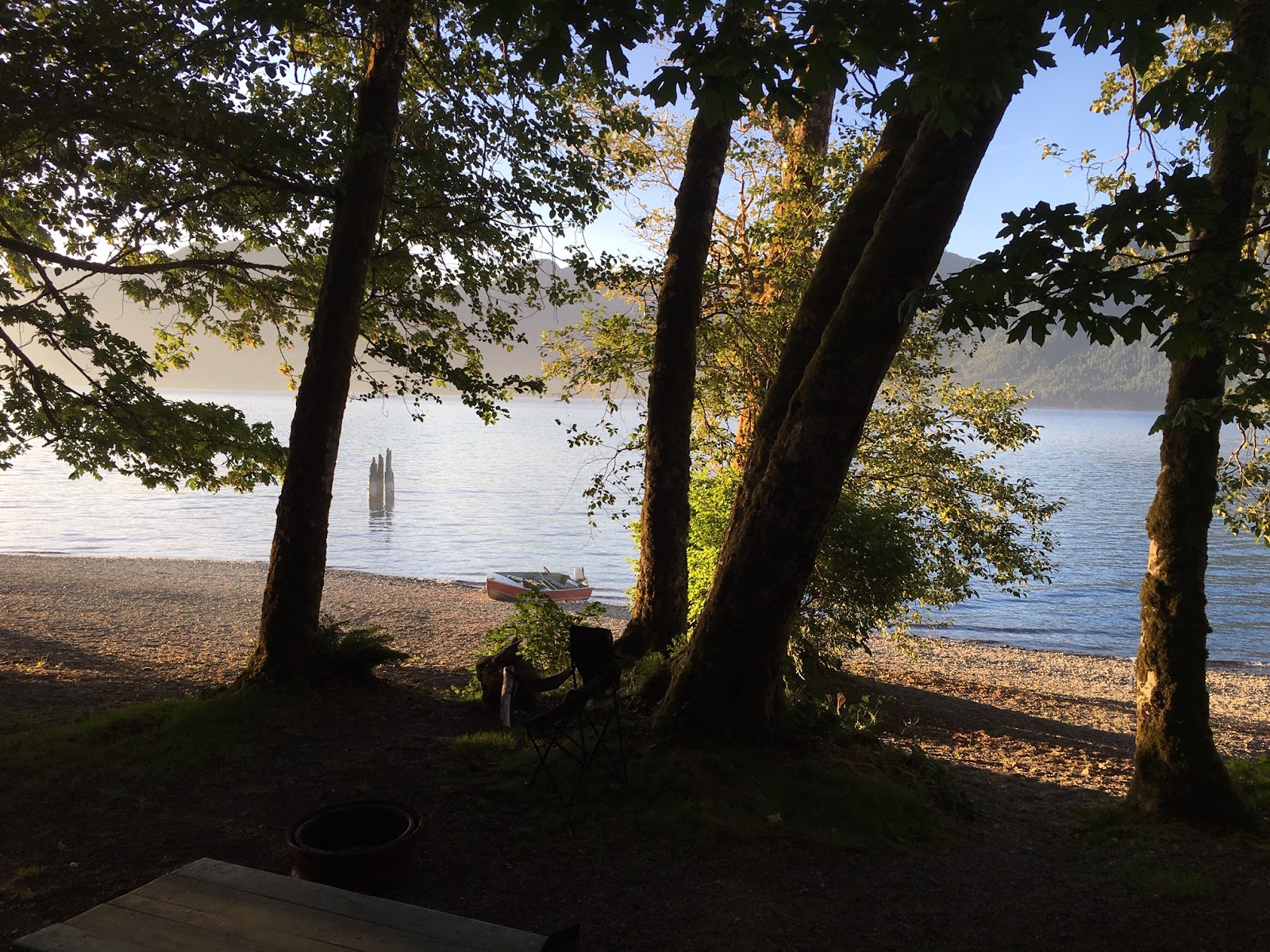
Driftwood Structures on the Lake Shore

Our Public Health Officer for the Province of BC, Dr Bonnie Henry, has encouraged British Columbians to get outside and enjoy the summer. Of course, to keep the infection rate of COVID-19 low, she reminds us to limit our contacts to (the same) small group, maintain a physical distance of 2 meters (six feet), wash hands frequently with soap and water or use hand sanitizer, and wear face masks in small enclosed spaces or indoors where physical distancing is not possible.

Sandy Beaches and Wildflowers

Our first camping trip of the year was to beautiful Strathcona Park, a huge wilderness in the interior of Vancouver Island. Established in 1911, it was the first provincial park to be designated in BC. A portion of the park lies within the Clayquot Sound Biosphere Reserve, a UNESCO environmental reserve.

In the 1980's, the government of the day wanted to make the park smaller in order to expand industry into the area (mining and logging). Many people came out and protested, setting up road blockades. As a result, the park was saved and even expanded. A park management plan was set up.

It contains a number of tall mountain peaks, including the Golden Hinde at 2,198 meters (7,211 feet), the tallest mountain on the Island. The park also contains Della Falls, the highest waterfall in Canada. Della Falls is not easy to get to. There is no road access. People can get to it by canoeing down a lake, and then doing a challenging hike.

We did not go to Della Falls, but we did visit several other spectacular waterfalls in the area, which I will write about in a separate post.

A Windy Afternoon at the Lake

Strathcona Park has two large provincial campgrounds that can be accessed from Campbell River via the Gold River highway. They are the Buttle Lake and Ralph River campgrounds, both situated on Buttle Lake.

As it turns out, everybody in BC has decided to go camping this year. What better time than a pandemic to enjoy the beautiful outdoors? The provincial parks and most of the regional parks as well are giving priority to BC residents for camping reservations. It is almost impossible to get a reservation at many parks. And, whereas in years past, we were usually able to get a non-reservable campsite via the  "first-come-first-served" system, now many of the campgrounds are reservation-only.

So we felt very lucky to get a site for four nights at Buttle Lake. We were also lucky that our trip there was earlier in July when the weather was cloudy and cool; therefore the hiking trails and beaches were not crowded.

Although we had brought our belly boats and fly fishing gear, we ended up not taking our boats out on the water as it was quite windy most days. However, we did fish from shore (spin casting) and I caught and released a small one.

Environmental Restoration

A Beautiful Hike Through a Hemlock, Cedar, and Douglas Fir Forest
Along the shores of the lake, we saw environmental restoration of the sandy banks in progress. According to the informational sign, parks staff are exploring various methods of reclaiming damaged areas. What you are looking at in the photo above are segments of branches, or withies, that have been stuck in the ground and allowed to root. They used native plants such as willow, red osier dogwood, and cottonwood.

Site of Historic Battle
We did a lot of hiking on our short camping holiday. We explored most of the trails in the park that were within walking distance of our campsite. Our hikes included walks all along the lake shore and out to a marine campground, a hike to a lovely stream, and the Darkis Lake loop.

We also some side trips. including a hike to Lady Falls, a hike to lower Myra Falls, and a hike to Upper Myra Falls.

On one of the days there, we did a road trip to Gold River, an area of the Island I had never seen before. The highway curved around Upper Campbell Lake, then followed the Elk River to Gold River, a small community situated near t


he head of an inlet on the west side of the Island.

High above the river, we stopped at a historic site. According to the information sign, it was at this location the the Muchalaht and Mowachaht people met and had a battle.  Since that time, the two First Nations have combined.

This is an area I would be happy to visit again. There are so many areas to explore, and many lakes that are great for fishing.

But, during the summer of 2020, I predict that the competition for camping sites will continue to be fierce.

Saturday, October 26, 2019

A Tour of Vancouver Island

I am finally writing a long-promised post about our beautiful summer vacation. We have now lived on Vancouver Island for more than two years. We decided that this summer, it was time to get to know our new home a little better.

We live along the east coast of the Island in an area that is considered to be the central part of the Island (even though it's quite close to the southern end). In late July, we set off in our truck and camper rig to explore the less-travelled roads of southern Vancouver Island.

Cowichan Valley

Our first destination was the Cowichan Valley. We camped for three nights along the south shore of beautiful Lake Cowichan.

View of Lake Cowichan from our Back Door
Rob's Waders
There were two small islands in the lake not far from where we camped. We went out in our belly boats and spent several hours fishing around and between the two islands. We didn't get a single bite. The people camping next to us caught some fish, though. They said the fish were out in the middle of the lake and very deep.

Most of the time we were at Lake Cowichan, it was quite windy. So we did some short hikes and read books on the beach and enjoyed camper cuisine.

Hiking a Section of the Trans Canada Trail

On our last day, we drove into the community of Cowichan Lake, and explored some of the rail trails -- old railway lines that have been turned into hiking trails -- that wind through the area. We hiked a section of the Trans Canada Trail.

The Trans Canada Trail is a network of trails that stretches all across Canada, with many parts still under development. Over the years, I have hiked or cycled on several segments of this trail, especially in the Greater Vancouver area, Nanaimo, and in the Kettle Valley.

The section we were on runs between Cowichan Lake and Shawnigan Lake, about 20 kilometers. (We only went about 5 km, then doubled back).

Lizard Lake

Old Growth Stump
 Leaving Cowichan Lake, we followed the Pacific Marine Highway southwest toward Port Renfrew on the west coast of Vancouver Island. Along the way, we stopped and camped at a beautiful little campground at Lizard Lake. The lake got its name because of the salamanders that live in the lake. I sat quietly beside the water peering in and was rewarded by seeing a couple of the salamanders swimming in the lake water.

There is a nice hiking trail all around the lake. We saw evidence of past logging activity in the form of giant stumps. The lake is stocked with rainbow trout, and we enjoyed fishing in our belly boats. As well, there is a swimming beach.

Lush Vegetation Along the Trail
Port Renfrew, Botanical Beach, and Botany Bay

Our next stop was Port Refrew. This campground brought on nostalgia, as we camped beside the Gordon River, exactly where I camped nearly 40 years ago when I was setting off to hike the West Coast Trail. The West Coast Trail is a 5-7 day backpacking route through the Pacific Rim Park on the west coast of Vancouver Island. Is is famous as a world destination for backpacking.

Rob and I spent an afternoon hiking a section of the Juan de Fuca Marine Trail starting at Botanical Beach, which is its most westerly trail head. This was a real highlight of the holiday for me. I loved the rock formations, the tidal pools, and the wild beaches. Botanical Beach is reported to be one of the richest areas of marine tide pool life on the west coast of the Island.


Botanical Beach
Kelp Tangles


Here are two pictures of Rob.
 
He is hiking over the layers of rock to the tide pools. In the other photo, if you look past the pile of kelp, you will see him sitting on the rocks.

We enjoyed our lunch sitting on the rocks, basking in the sun, and absorbing the sounds and sights of the shore.
Rock Formations


Exploring the Beach
Rock Stack, Log, and Tidal Pools
This was an excellent afternoon. It was the first time that I have hiked any part of the Juan de Fuca Marine Trail. I would like to hike the whole 47 kilometers of the trail someday, maybe section by section.

We finished our hike by doubling back to where we started, and then hiking the Botanical Beach to Botany Bay 2.8 km loop.

After that, it was time for some refreshments. So off we went to the Port Refrew Hotel for a pint and some delicious west coast seafood.

 Jordan River and Mystic Beach

We spent the last few days of the trip at Jordan River, camped right along the beach looking south over the Juan de Fuca Strait at the Olympic Peninsula in Washington State. Jordan River is a surfer's paradise in the fall and winter when the waves are big. But at the beginning of August, there were no surfers to be seen -- just a lot of seagulls.

We spent an afternoon hiking into Mystic Beach, another famous destination along the Juan de Fuca Strait.
Mystic Beach
The Trail is Badly Eroded

Unfortunately, the hike has become too popular. The trail has been severely eroded, and there were a lot of people along the trail and at the beach. It is a beautiful beach, however. Also, we got to cross a suspension bridge along the trail.

We really loved our beach campsite at Jordan River. There was a quaint coffee shop up the road, and a Little Free Library. That was a good thing because I had read all the books I brought and was in need of more reading material!

Last Night at Jordan River
After more than a week on the road, we headed for home. We bypassed Victoria, not in the mood for an urban experience after the peacefulness of the wilderness. But, our holiday wasn't finished yet! We spent a few days at home gardening and doing laundry, then we headed off on another adventure. So, dare I say, there's more to come?

Monday, July 9, 2018

Camping With the Kiddles

Camping might just be the quintessential Canadian pastime. That is what we have been up to this past week. We went camping with my daughter's family at a lake on the northern part of the Island.

Yes, I did mean to type "kiddles." It rhymes with "littles." We were camping with the grandchildren, which is the best kind of camping of all.

The Belly Boats and Kate

We brought our dog Kate along with us. Of course, it was not without incident. She began breathing in a laboured way on Thursday, just before the long weekend, and we planned to leave Monday morning. A visit to the vet on Friday provided reassurance and we purchased some expensive anti-inflamatory medication and an analgesic. Her breathing immediately went back to normal and she seemed fine throughout the trip, cavorting around like a dog half her age.

Rob Fishing in the Belly Boat
The belly boats had been packed away since the move. It was great fun to get out on the lake in them and do some fly fishing. We were fortunate to have several days of glorious sunshine. Although it was obvious that the lake was full of fish as they were rising all around us, we only hooked one fish, but I lost it. However, the loons on the lake looked sleek and well-fed.

Beach Time
The little lake had a large area with a sandy beach, and it was terrific for swimming. The beach was also a good place for building sand castles. Our double campsite was right by the lake and it had its own little beach area.

On a Hike. The Pilings in the Water Were Supports for a Bridge Built During the Early Logging Years.
We went on several short hikes while we were there. Our small lake was situated beside a much larger lake which is part of the Sayward Forest Canoe Circuit, a 48 kilometer loop. Of this, 40 km is paddling and there is 8 km of portage. We paddled the Bowron Lakes circuit in central BC several years ago and had a wonderful time, so we feel tempted to do this one now!

In the Camper One Rainy Afternoon
The boys had their bikes along and spent some happy hours riding up and down the gravel road through the campground. We had one afternoon and night of rain. It was a perfect opportunity to retreat to the camper and read, play cards, and play early literacy games. There was no wifi or cell service. (Yay!)

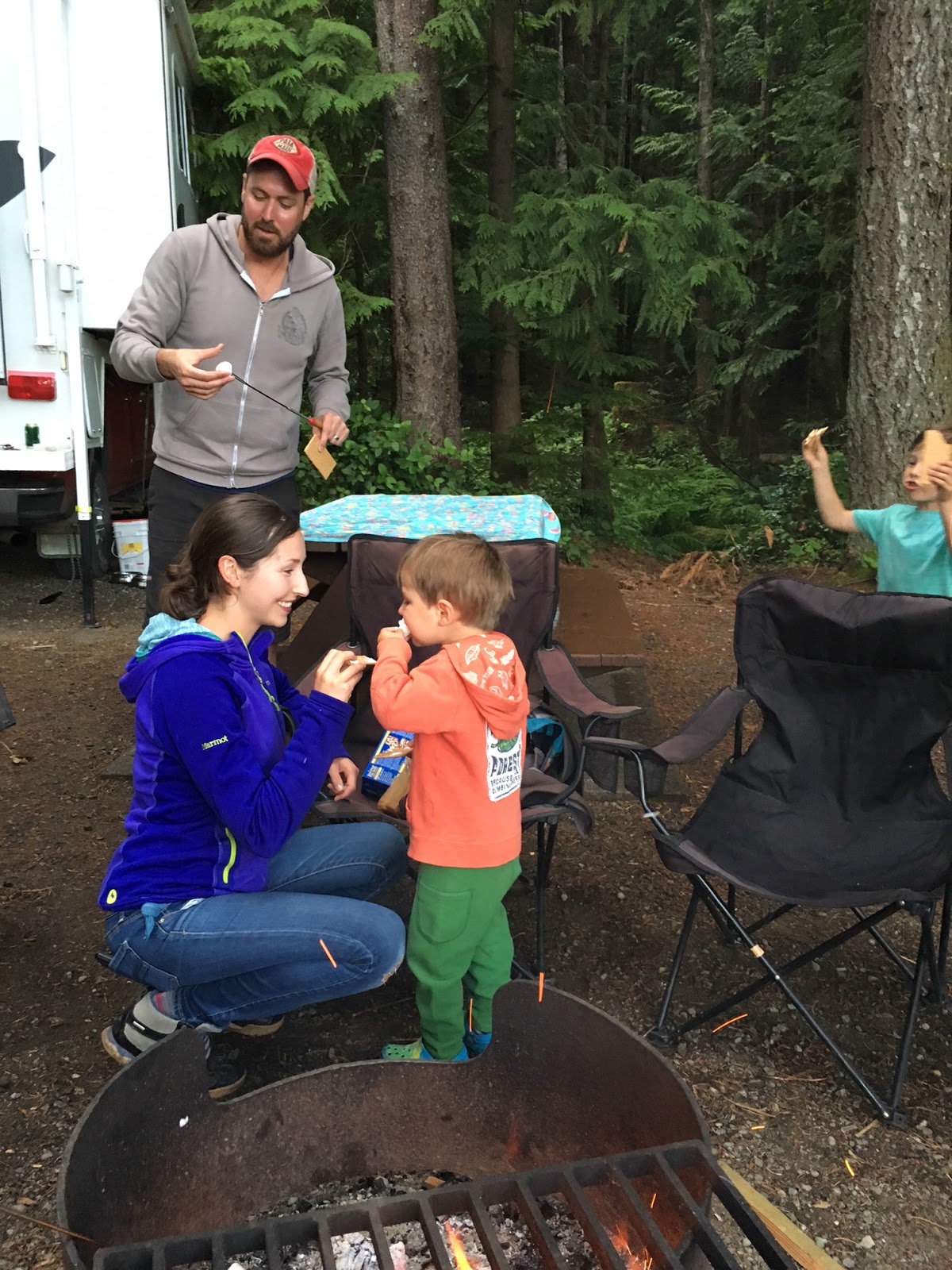
We Spent Time Around the Campfire
As the forests are not dry at this time, there were no restrictions on campfires.

Enjoying some fresh BC Cherries
There were cherries!

Roasting Marshmallows
There were marshmallows!

More Marshmallows
There were S'Mores! In case you are wondering what S'Mores are, they are melted marshmallows layered with chocolate inside of graham crackers, kind of like a sandwich. The chocolate melts because it is close to the hot marshmallow. Yum!


And More Marshmallows
The boys were thrilled so see their uncle when he was able to join us at the campground for the last two nights.

The Sun Going Down
The last night at the lake provided some great photo ops. There was a beautiful sky as the sun set.

Sitting Around the Campfire
If going camping is the quintessential Canadian summer experience, then sitting around a campfire at night staring into the flames and enjoying a beverage or two is the quintessential camping activity. We turned our Canada Day celebration into a Canada week!

Saturday, October 21, 2017

One Small Action


Spawning Sockeye*

Underwater Photography

As we get to know our new community, we have gradually begun to participate in activities and events here. Recently I attended a talk by a noted local underwater and landscape photographer, Eiko Jones. I was not familiar with Jones' work and had no idea what to expect.

As it turned out, I was completely blown away by his fabulous photos. Eiko Jones takes many of his underwater photos in local rivers and swamps on Vancouver Island, as well as in the ocean. His story of how he obtains his amazing underwater or split screen shots is almost as fascinating as the photos themselves. Essentially, he dives down and lies on the bottom of the riverbed, sometimes for more than two hours, taking hundreds of shots to get those one or two perfect images.

British Columbia (BC) and Alaska have one of the world's last great salmon habitats. Many of Eiko's photos showed the five species of returning and spawning salmon, and young salmon fry. Lately, in order to not disturb salmon in spawning beds with the bubbles from his scuba gear, he has taken to free diving.

I have lived in the watersheds of two of BC's major salmon bearing rivers most of my life, and am well aware of the importance of salmon to the ecology as well as to people, especially the First Nations peoples whose livelihoods depend on salmon. Eiko's photos of salmon who had fought their way back to their native stream to spawn and then die, along with his accounts of successful salmon stream rehabilitation, almost brought me to tears. Please click on the links to see examples of his photography.

Elder College Public Lecture

I have just discovered that there is an active Elder College program in my area. They are hosting a series of three public lectures in a nearby community centre. The topic for the speaker series is: Achieving Global Sustainability: A Decent Life For All. Unfortunately I missed the first talk, but I went to the second one in the series, which focused on global climate change and sustainable development.

I am deeply concerned about climate change. An obligation that rests heavily on my shoulders, now that I have retired, is to find ways to contribute meaningfully to society, and, in some small way, to help work toward solutions to the overwhelming and urgent problems that face humanity on a global scale. Climate change is one of many huge, interrelated problems, along with poverty, overpopulation, food insecurity, violence, gender inequity, and so on. It can seem overwhelming and hopeless. How does one even know where to start? How can one person's actions make any difference in the face of such urgent and difficult problems?

But thinking about it that way is defeatist. Trying to put pressing world issues out of mind and doing nothing does not alleviate my worrying about them because I still know the problems are there, like a monster in the closet. Having been present in Eiko Jones' talk, it was fresh in my mind how one person, through his exceptional photography, was gently educating people about ways to rejuvenate salmon streams, and why it is important.

As I listened to the sustainability speaker, I realized a couple of things. One is that almost nothing that he said about the causes and solutions to climate change and global sustainability was new information for me. Over the years, I have been reading and educating myself about these issues.

Another thing I realized is that many people from all countries of the world have been working for years to establish and implement global sustainability goals. In 2015, countries around the world adopted the 2030 Agenda for Sustainable Development. This global agenda identifies 17 sustainability goals, readily available on the United Nations website. Also in 2015, signatories to the Paris Agreement on Climate Change agreed to take action to limit temperature change to a maximum of 2 degrees Celsius.

So, in contributing my part, I am not alone. I am joining people around the world working toward a shared vision. One plus one plus one is how we get there.

A third thing that I realized is that I have been making choices for decades now to live in ways that are more environmentally conscious. In many little ways, I already have been doing things that align with the UN's 17 sustainability goals. Of course, there are many more changes that I could make. Just as people can join in one by one to work toward a shared goal, an individual can make personal changes one by one, and it all adds up. Here is a list of easy things to do: The Lazy Person's Guide to Saving the World. It is a great starting point.


One Small Act: #globalgoals

Upon coming home from the sustainability talk, I went online and read the UN's 17 sustainability goals. In doing so, I almost plunged into helplessness and hopelessness again. The problems are so big. The goals are so idealistic. 2030 is only 13 short years away!

But then, I decided that although I couldn't solve the problems of the world today, I could do one small thing today.

Goal 2 is to end hunger and increase food security, globally. This is one area in which we have made significant strides over the last 30 years. Although the world population has continued to rise, the absolute number of people in extreme poverty without access to adequate food has decreased. However, poor nutrition remains the biggest single cause of child mortality for children under five. For decades, we have known that the best way to improve the nutrition and health of babies and young children is for mothers to breastfeed. Yet Nestle corporation continues to market baby formula and powdered milk to the poorest countries of the world, making false claims that it is a more healthy choice.

So today, I joined the boycott of Nestle products. This link is to the most up-to-date list I could find for Canada. It includes links to the boycott lists for the USA, UK, and Australia. I printed the list and put it on my fridge. Then I sent it to three other people. That was my one small act for today.

*This is a free public domain photo by an unknown photographer. Follow the links to see Eiko Jones' photographs.

Saturday, August 20, 2016

Rainbow Trout

Bluff Lake

I grew up in northern British Columbia in a village that incorporated to become a small town when I was a child. My father's family moved to the valley in the early 1900's and homesteaded and farmed. Our family was one of the first settler families in the area. 

Although our little town had all the amenities -- a paved Main Street, power, water, and sewer, and even one television channel beginning in 1963, a pioneer lifestyle still was the norm in much of the surrounding wilderness area. During the 60's and 70's, many young people from across Canada and the United States were attracted to the area because of the chance to live a back-to-the land lifestyle, and they brought cultural richness in the form of diverse ideas, music, and the visual arts. Many have remained in the area and raised their families. 

When I was growing up, we did lots of hiking, skiing, and exploring old back roads as a family. We also gathered the riches of the land. For example, in the Fall, we picked huckleberries and blueberries, which my Mom canned or froze. My parents had a large vegetable garden, berry bushes, and fruit trees. In my younger years, my father hunted for moose, deer, and grouse. My Dad made wine out of native plants, such as choke cherries and dandelions. A typical Sunday afternoon activity for the family in the Fall was cruising the back roads with a 22 rifle or a shotgun, looking to get a couple of grouse for dinner. 

And, of course, we went fishing. My Dad was an avid fly fisherman, and one of my earliest memories is of picnicking at Driftwood Creek and hunting for fossils while my Dad fished the creek for rainbow and cut throat trout. As he was a skilled fly fisher, we often came home with trout for dinner. We also fished for salmon, steelhead, and Dolly Varden in the rivers, and rainbow trout, lake trout, and Kokanee in the many lakes in the area. My Dad (who was not a naturally patient man) took the time to teach my three brothers and me how to fish, although as we had to take turns with the rod, it never seemed to me that I had enough fishing time. 

When I grew up and went to the city for university, and then later married and lived in one city after another, I missed the hiking and skiing that I had grown up with, so I strived to make opportunities for these two pastimes that I loved. However, I hadn't realized that I would also miss the gathering and eating of wild foods, and that I would miss fishing so much. These were two things that I seldom had the opportunity to do.

After my first husband passed away, I raised my three children as a single mom for many years. During visits to my childhood home, my Dad and my brothers sometimes took my kids (and especially my youngest son) fishing. When I moved back to northwestern BC, my dear friends sometimes included us on fishing trips, and one of my closest friends, who is a renowned fly fisherman offered my son and me some fishing instruction. 

Fly fishing is not a skill that can be picked up after a few tries. It is something that takes years of dedication and practice to master. I did not have my own fishing equipment or the time to practice. But I still yearned to fish. My friends and family surprised me with a big birthday party when I turned 50, and gave me waders, wading boots, and a fishing rod. I few years later when I met and married my second husband, who loves to fish, he took me under his wing, and began teaching me both how to spin cast for salmon and dollies in the rivers, and how to fly fish. I absolutely love fishing, especially fly fishing (even though I am still not good at it at all). There is something so peaceful about standing out in a wild river casting the fly line and sometimes catching one.

However, for the last four years, we have been living on the prairies, far away from any good fishing rivers. The few rivers closest to us are so crowded with fishermen that it does not seem sporting at all. 

We presently are on a camping trip in the West Chilcotin area of British Columbia. We spent three days at a great little fishing lake, and went out fishing in our belly boats every day. We have been fly fishing: dry fly, wet fly, and sink tip. Two days ago, Rob caught a twelve inch rainbow trout, and we fried it up for lunch and ate it with the potato salad I had made the day before. It was delectable! 

Finally, yesterday, I managed to actually land a fish that I hooked. I had just started to feel quite discouraged, then I managed to catch a beautiful twelve-inch rainbow trout. I caught another small one and released it. I hooked another good sized one and brought it up to the boat then lost it. Meanwhile, Rob caught and kept four smaller pansized rainbows. (He also caught and released several). So we had another amazing feast of rainbow trout. It has been many years since I have eaten trout. (I refuse to buy the dull, sad looking fish that the grocery store sells as "fresh trout.") The rainbow trout was delicious, and it took me right back to my childhood, fishing with my family. This has truly been a wonderful holiday.

Tuesday, August 16, 2016

A Perfect Lake

We are presently camped at a beautiful little lake, the name of which must remain unwritten, as Rob is certain that if I mention it on my blog, hoards of people will suddenly descend on this remote location in the West Chilcotin area of British Columbia. We are staying at a BC Recreation Site. There are four campsites at this rec site, and each one is large, open, private, and with easy access to the lake. Each one has a picnic table and a fire pit, and there is a relatively clean pit toilet. 

We discovered "Nameless Lake" on our way to Bella Coola. We arrived in mid-afternoon and found that we were the only ones at the rec site. The lake was glassy calm, and there were fish rising and jumping in every direction. We quickly set up the camper, and then got ready for fishing: sunscreen, bug dope, hats, inner layer, waders, fishing rods and flies, fins, and belly boats. Soon we were out in the lake fishing and it was lovely. There is an island about three hundred meters out across from the rec site, and another smaller island to the east. 

At first we both fished just offshore in front of the rec site. I was fly fishing with a sinking tip with a timberline emerger, and casting, trolling a bit, and then casting again. As I gained confidence with the boat, I began to make my way towards a narrows between a point and the western tip of the island. I was drawn to that location because I could see a lot of fish rising there. Sure enough, I began getting bites. I hooked an 8-9 inch (est.) but lost it. Then I caught a bigger one, and played it up to the side of the belly boat. It was big enough to keep, and I suddenly realized that I didn't know how to land it in the belly boat, and also I had nothing to bonk it with. As I messed around with my rod and the line, the fish managed to shake itself off. 

While all this was going on, some big clouds were forming in the west. I noticed them, and started to slowly fish my way back across the lake toward the rec site. All of a sudden, a brisk wind came up, blowing from west to east. Waves were slapping against the boat. I quickly reeled in and began to kick my way across the lake as fast as I could. I hadn't realized how far I had gone. Belly boats do not move very fast, and I got a real workout trying to cut diagonally across the wind. I was worried that I would be blown onto the island and not be able to get back across the lake. I was also worried that the wind would blow up into a thunder and lightening storm, in which case it would be very dangerous to be out on the water. 

Sensible Rob was fishing near shore, just west of the rec site. He called to me to come back across, not able to see by my slow progress that I was giving it all my effort. I did manage to make it across the lake to shore. By the time we beached our boats, there were whitecaps on the crests of the waves, and the waves were pounding on the shore. We tied our belly boats to a tree so they wouldn't blow away. Later during dinner, we saw lightening strikes in the distance, and in the night there was a huge thunder and lightening storm. It was still raining in the morning, so we moved on. 

We are now on the return trip from Bella Coola, and have come back to Nameless Lake. A couple from Courtenay that we had met at another campsite a few nights ago is camped at the site one over from us. A young couple with a van and a blue tarp stretched out over their table is camped on a huge grassy spot beside the lake. They have set up a camera on a tripod to take pictures of the meteor showers that are supposed to happen tonight. And a person with a BC government truck is camped in the fourth site. 

Fish Tales

We fished in the belly boats when we arrived yesterday evening, and again this morning. Today was a gloriously sunny day. The fish were biting this morning. I had many strikes, and reeled in three. One I released, and the other two shook themselves off as I brought them up to the boat. I am still not sure how to actually land one. 

This afternoon, I set up my easel and painted a small plein air scene of trees with long shadows and the little rutted track winding down to the rec site. Meanwhile, Rob chopped some firewood and then went out fishing again, but it was quite windy and not very pleasant. We had a bonfire this evening and roasted weiners. Also, I made potato salad. A fine evening, which concluded with a hair wash and shower. Oh, the luxury of the camper. If Rob had his druthers, we would stay here for weeks!

Sunday, August 14, 2016

Belly Boats

At the end of July, we set off on an epic camping trip across northern British Columbia. We have a pickup truck with a camper on the back. I call it "epic" because we are going to be on the road for seven weeks, staying in the camper. Much of that time we will be in places that have no Internet service. 

I love our camper. It is a very cozy little home on wheels. Although space is limited (how much can you fit in the bed of a pickup truck?), there still seems to be room for everything we need. We have a comfortable bed, clothes, dishes, food, and a small bathroom with a shower. The camper has a furnace to take the chill off on cold nights (it is a three season camper). On this trip we have brought along with us fishing equipment, my plein air painting supplies, some books, cameras, iPads, crib board, and our mountain bikes. 

Our first destination was the ArtsWells Festival in Wells, BC. Wells is a tiny village (population 250) in the interior of BC, east of Quesnel. This area was settled in the late 1800's during the gold rush. There are still mining claims in the area that are being actively worked. Nearby Barkerville has been restored and is a popular tourist destination. Fifty years ago, Wells nearly became a ghost town. However, a number of artists moved into the community and restored many of the old buildings. They lobbied to keep the school open. 

Wells is now the home of Island Mountain Arts. As well as the four-day ArtsWells Festival on the August long weekend, which is mostly music, but also theatre, literary events, and visual arts, the community also hosts visual and performing arts workshops and courses throughout the year. Some of my favourite music events of the weekend were Ken Hamm, Aurora Jane, Carole Pope, Coco Love Alcorn,  Jenny Ritter, Kym Gouchie, Scarlett Jane, and Quique Escamilla. 

We had a great camping spot behind the Jack O' Clubs Pub, near the river. One of the days that we were there, we rode our bikes to Barkerville and had lunch and spent the afternoon there (and took in a Ken Hamm concert in the Methodist church), then rode back. Another morning, we hiked some of the trails along the Willow River and Williams Creek. As the whole area has been so extensively mined, these watercourses, Jack O' Clubs Lake, and the village of Wells itself are built upon and surrounded by old mine tailings. We also went and visited with Claire Kujundzic and Bill Horne, two of our favourite artists who run the Amazing Space art studio and gallery.

And what does all this have to do with belly boats? Well, as we were travelling over the Interlakes highway between Little Fort and 100 Mile House, we camped one night at a little fishing lake. This whole area is a world class fishing destination. We, however, are only set up for fly fishing in rivers, not for lake fishing. So we stood on the shore looking out at the pretty little lake, and watched the fish jumping and rising in every direction. We knew that later in our trip we would be travelling through another area with many fishing lakes. 

So, when we pulled into 100 Mile House, we went to a fishing store and bought ourselves early birthday presents. Belly boats. These are essentially inflated truck inner tubes for fishermen to sit in while floating out in lakes. They wear waders with flippers on their feet to propel themselves through the water.

Our belly boats at Puntzi Lake

Yesterday we got to try out our belly boats. We are at Puntzi Lake, a famous fishing lake along the route to Bella Coola. What fun! It was lovely to be out in the lake with the loons and the gulls. Apparently the rare white pelican is nesting at this lake this year, so maybe we will see one. We got a couple of bites, but didn't catch anything. 

Rob fishing

When it started to rain, we finished up and went back to our campsite and had dinner. There was a tremendous thunder and lightening storm in the evening, but we were warm and cozy in our camper.