Showing posts with label global sustainability. Show all posts

Thursday, August 26, 2021

Afraid, Disappointed, ....and yet still Hopeful

Photo of Lytton, BC, by Cole Burston, The Guardian

Afraid

I am afraid. No, I am terrified.

We have spent the last 18 months living through a global pandemic. 

This summer, wild fires ravaged British Columbia, making this the worst wild fire season on record. At any given time, as many as 280 fires are burning in the province, and people in communities throughout the southern interior have been on evacuation alert, or evacuated from their homes for days at a time. 

The small community of Lytton burned to the ground during the heat dome earlier in the summer. In addition, as many as 570 people in BC died this summer as a result of high temperatures during the heat dome.

I live in a part of BC that is a rain forest. Yet, we are experiencing a level 5 drought (the most extreme level) and haven't seen more than a few drops of rain in two and a half months. The soil is rock hard, the local trails are closed because of fire risk, and the shrubs in our garden are dying. Rivers are running dry, salmon are not returning to spawn, and marine life has been decimated by high ocean water temperatures combined with extremely low tides.

People all around keep saying, "Get used to this. It's the new normal." But it's not the new normal. Things are about to get much, much worse. Because if we don't take action immediately and worldwide, we face the specter of of runaway, unstoppable global warming, according to the sixth IPCC report on the physical science of climate change. 

That's why I'm terrified.

Disappointed

We are currently in the middle of a federal election campaign in Canada. Two years ago, the Liberals under Justin Trudeau were elected with a minority government, and now Trudeau has called another election in hopes of obtaining a majority this time around. 

In a recent survey asking Canadians what they think is the most critical threat facing Canadians, more people cited climate change than any other issue, including government deficits, unemployment and the economy,  income inequality, and food security. Eighty-eight percent of Canadians said they have been personally impacted by climate change, and 78% said "they are very concerned about the negative impact of climate change on future generations." Between 73% and 84% of respondents recommended the following solutions: Industry adopting cleaner energy sources, increased use of renewable energy and clean electricity, use of new technology to offset carbon emissions, reduced fossil fuel usage, and implementation of government policies to support all these solutions. 


Yet, climate change has scarcely been mentioned by party leaders on the campaign trail. One exception is Annamie Paul, leader of the Green Party of Canada, who, unfortunately, has received relatively little press coverage. 

We don't have much time left to shift our trajectory away from uncontrollable heating of the earth. An election campaign is the ideal time to focus on the changes we want to see, and to elect leaders who will work to address climate change. 

So, I am disappointed. Disappointed and scared.

I am disappointed that the Liberals have made little progress toward meeting climate change goals during their two terms in office. Instead, they used our tax dollars to buy a pipeline. 

The New Democratic Party is a socially progressive party that I supported for years. Now led by Jagmeet Singh, the federal NDP has been silent on climate change policy and instead, seem to have put their efforts into propping up the Liberals. 

And, while federal and provincial politics are different, our provincial NDP party under John Horgan has been a huge disappointment on environmental matters. They have have gone ahead with Site C dam development in the northeast of BC, a liquid natural gas plant in the northwest, and spent millions of policing dollars to harass and arrest protestors at Fairy Creek, Canadians fighting to save one of the last intact old growth ecosystems on southern Vancouver Island (796 people arrested since May). This has occurred despite a forestry report they commissioned recommending a moratorium on logging stands of old growth, which the provincial NDP pledged to support last fall. 

The federal Progressive Conservative party platform under O'Toole, not surprisingly, recommends increased criminal penalties for Canadians who protest against pipelines or other "key infrastructure."

Aside from the Green Party of Canada, our federal parties are not taking the climate emergency seriously. 

Therefore, I now actively support the Green Party, federally and provincially. Rob and I went out a few days ago to put up some large Green Party campaign signs. As we wrestled with the big heavy signs, struggled to pound stakes into soil that was as hard as concrete, and tore our jeans on blackberry brambles, at one point we looked at each other and asked, "Where are all the young people?" 

In our electoral district, why are the people erecting the signs, running as candidate, and coordinating the campaign all old-age pensioners? Where are the people in their twenties, thirties, forties, and fifties? Have they given up on the democratic process? Are they too busy, too cynical, too alienated, or . . . ? I'm disappointed.

Still Hopeful

Yet, I am still hopeful. I am grateful to the many protestors at Fairy Creek, people of all ages, who have showed up week after week for the past year to protect the old growth. Some of those big trees are a thousand years old, and they are very effective carbon sinks. Old growth forests provide habitat for animals, including many on the endangered list. Only 2.7% of BC's old growth still remains, and once it's cut it's gone forever.

The RCMP arresting protesters at Fairy Creek, The Narwhal


I am still hopeful, as many of the younger people in my life are very involved in making the world a better place. They are working to raise awareness about issues of social justice, including violence against women, mental health support, and acceptance of racial and gender diversity. They work to improve public transportation, environmental health, and community planning to address climate change. Social justice and climate action go hand-in-hand.

Having seen the way the scientists, medical experts, and leaders at all levels from local to international have worked together to adopt public health measures to keep us safe and to develop a COVID vaccine in record time, I know that humans around the world can accomplish a lot in the face of an emergency. It gives me hope that we will attack the climate emergency with the same sense of urgency.

We still have a window of time, although it is shrinking rapidly, to avoid the worst consequences of climate change. 

One place we all can start is by getting involved in this federal election. Ask your local candidates how they will address climate change. Ask them about specific issues, like old growth forests, pipelines, raw log exports, job transition support for resource workers, and corporate subsidies. Get the climate emergency into the spotlight at campaign events. Learn what each party's platform says about climate targets. Volunteer to help out in the campaign of a party that has a strong record of action on the environment.

Still hopeful. 

Sunday, January 19, 2020

Why It's Worth It

A Beautiful World and I'm Grateful to be Here
I think everyone asks themselves this question from time to time. "Why is it worth it?"

The question can take on a different shape depending on circumstances. It can mean: why is it worth persisting with this hard thing I'm trying to do when at the moment it seems so unrewarding and difficult or even hopeless, and nobody seems to appreciate it? This version of the question is about taking on challenges that help us grow, help others, and help make the earth a better place. It takes commitment to persist with an intention or goal when we find ourselves seemingly inadequate for the task, the way forward isn't clear, or when others obstruct our efforts or fail to acknowledge us.

Or it can mean: Why is life worth it? Am I really here on this earth just to shop, pick up dog poop, fill out this form, and drink beer in front of the TV? In this incarnation, the question really is about the deep inner sense of one's existential purpose. Depression, illness, or discouragement sometimes might be a cue to examine inner needs that have been ignored and repressed. Existential purpose is hard to nail down and it seems to easily get derailed. We find ourselves using our time up instead on trivial matters, comfortable routines, or self-gratification. Or, perhaps some of us fill our time up with busyness and daily obligations as a way of running from an examination of the inner self and life purpose.

Or "why is it worth it" can mean: What's in it for me? On the surface, this appears to be a selfish concern, a desire to put oneself first, rather than thinking about others or broader life goals. Often, a person's answer to this question never goes beyond the level of personal material reward -- the paycheque, the ego stroke, the better fitness score, or the tit for tat exchange.  But, underneath, everything starts right here, right now, with the person you are inside. All important work a person does has to start internally, by recognizing and accepting the person you are, and checking in to make sure that your external efforts align with your core values. I'm coming to learn that when I run away from my inner self, then my commitments, efforts, and daily pursuits may become unsatisfying or even harmful.  

Lately I have been writing quite a bit about the climate crisis, and how it has motivated me to take various actions.

Although I cannot put into words what my core life purpose is, one part of it is the desire to make a positive difference in the world. Putting personal effort into educating myself about climate change, communicating about it to increase others' awareness, and taking personal actions to reduce my carbon footprint, all help, in a small way, to make a positive difference in the world.

It's worth if because of my beautiful children and grandchildren, and the future generations who will inherit the earth. I've written about this here, and here.

It's also worth it because the earth, its systems, and the living plants and animals are beautiful, amazing, and inherently worth preserving. Here are a few photos of the area where I live that I've taken over the last three months. They show the beauty of our world.

An October Afternoon in My Neighbourhood
Sunshine on the Pond
Snow Encrusted Trees at Mount Washington
Mount Washington at Four O'clock

Rock on the Forest Floor
Tiny Mushrooms in the Moss


The Backyard With a Foot of Snow
We live in an amazing world, and I'm grateful to be a part of it. It's worth it.

Sunday, January 12, 2020

Six Months Later

A Shopping Moratorium


Regular readers will remember that a little over six months ago, I wrote a post declaring that I was going to embark on a six month moratorium on buying any clothing, shoes, or jewellery for myself.

The reason I am concerned about shopping is that our North American materialistic lifestyle is not sustainable for the Earth. Every item of consumer goods that we purchase has a high carbon cost, which comes from obtaining the raw materials for the item (mining, logging, growing cotton, etc.), deforestation that ensues from activities like mining, logging, or growing cotton, the manufacturing process which uses energy and often environmentally toxic chemicals, the non-reusable packaging of the goods (often in plastic), and the transportation of the item to the end user, often from the far side of the world (burning fossil fuels).

When people buy things, they're often replacing items that are still serviceable (if no longer fashionable), or repairable (but who knows how to darn socks anymore? And what about the built-in obsolescence of iPhone batteries which can't be replaced?). The unwanted items typically end up in landfills. The carbon footprint from unnecessary consumption contributes to climate change.

So how did I do in these past six months?

Well, I'm not a really big shopper in general. But I do have a lot of clothes, which are mostly office wear left over from my work life before I retired. So I thought I wouldn't have much difficulty cutting myself off from shopping for clothes, shoes, and jewellery.

I announced my shopping moratorium on June 28, which meant it would be in effect until the end of December, 2019. In fact, I posted the blog article in the airport, as my daughter and I were waiting to board a flight to Crete. We were heading off together to a yoga retreat!

And wouldn't you know it -- the airline lost our luggage. We were going to spend a week-long retreat at a remote location on the edge of the Libyan Sea and we had nothing to wear but what we wore on the plane. So, only two days after stating my intention to not shop for six months, I was running around Heraklion buying clothes. You can read about it here

 It was a truly wonderful holiday. More pictures here.

And so, I thought I would just shift the end date of my moratorium from December 29 to December 31 to complete six months of no shopping. (Note: I still allowed myself to buy clothes for others -- e.g., souvenir T-shirts for the grandkids).

But on the second-last day of our Cretan holiday, after we finished the yoga retreat, the whole group did a shopping trip to Rethymno. Then, my daughter and I spent one more day in the city of Heraklion on our own. Sad to say, in Rethymno, my will power wavered, and I bought myself a slender handmade silver bracelet as a memento of the trip.

Exploring Rethymno With My Daughter
Tempting Wares


Street Art in Rethymno
All the Retreat Group (Except Theo)
Restaurant Where We had our Last Dinner Together
So, you guessed it, I shifted the starting and end dates of the shopping ban again. It started on July 7, 2019 and ended on January 8, 2020. I am happy to report that I did not buy any clothing, shoes, or jewellery during those six months (in fact, I haven't gone shopping even yet). I wore out three pairs of shoes, and several clothing items. And, next time before I impose a shopping ban on myself, I will make sure that I have a good supply of non-ragged underwear before I start.

Carbon Offsets

All my life, I have wanted to travel to see other parts of the world. Yet, throughout most of my adulthood, my travel has been quite limited. Although I did travel for work, it was rarely to places that I would have chosen as a destination, and my time in each place was mostly spent working, not sight-seeing. Finances, parenting, and the time demands of full-time work limited my opportunities to travel.

So one of the top goals I had for retirement was to travel.

But, since I have begun learning more about the climate crisis, I have realized that flying causes a lot of CO2 to be released into the air.

It is important to reduce material consumption, shift from a high meat diet to a more plant-based diet, avoid wasting food, divest one's portfolio of petroleum stocks, burn less fossil fuel (in cars and in home heating/cooling), waste less water, garden organically, use less toxic household products, vote for environmentally focused political parties, speak out about climate concerns, and refuse plastic packaging. These are all lifestyle changes that I am trying hard to incorporate into my life.

But I undermine my own efforts to be a good climate steward when I do a lot of air travel. One solution is to fly less.

As much as I can,  I have eliminated taking domestic flights. For example, I live on an island. There are two main ways to get off the island -- by air, or by ferry. So I have been choosing the ferry. I was excited to read that a local small airline hopes to put an electric airplane into service within the next two years for short trips from the Island to the mainland.

This summer, Rob and I vacationed close to home, camping nearby on Vancouver Island. That way, we didn't have to fly anywhere, or burn a lot of gas on a long road trip.

But I haven't yet eliminated all air travel from my life. Although I feel guilty about flying, I also am not ready to give up my lifelong goal of travelling to other parts of the world.

So along with flying less, my solution is to purchase carbon offsets for every flight that I do take. Although there are a number of organizations one can use to do this, I use Gold Standard. A video from their website explains the concept of joint action on climate change, and how purchasing carbon offsets makes a difference.

The first step is to calculate your emissions. Gold Standard provides a way to calculate your annual emissions.  However, for calculating flight emissions, I prefer to use the calculator provided by myclimate.

As an example, I calculated that my return flight to Crete created 3.4 tonnes of CO2 equivalent emissions, and an upcoming trip will create 1.6 tonnes of emissions, so 5 tonnes in total for the two trips. I purchased carbon credits equivalent to my flight emissions, and chose to apply those credits to a project that provides clean water to Cambodian communities. It cost me $81 CAD.

Maybe some day I will go that extra step and stop all air travel. But, not yet. 


Monday, September 30, 2019

How Could I Have Been So Blind?

Photo of Fort McMurray wildfire in 2016 from CBC
 A Book About Oil

I am happy to report that I have finished Project X and sent it in. In the process, I did a lot of reading on topics related to the paper. One topic area that I read quite a bit about was global warming, and the climate change that is a consequence of global warming. This issue is something that I have been educating myself about for the past year.

I read the following book, Oil's Deep State: How the Petroleum Industry Undermines Democracy and Stops Action on Global Warming  -- In Alberta, and in Ottawa, by Kevin Taft, written in 2017. Taft was an elected MLA of the Province of Alberta from 2001-2012, so he had an inside view of the impact of oil companies on government. He has a PhD in Business and is an expert in public policy.

Although he is writing about a heavy topic, the book was fascinating to me because I lived in Alberta during part of the period he writes about. He describes how the big oil companies in Alberta, which are extremely wealthy, strategically used their money and power to influence politicians, researchers, and the public in order to bring in a national energy policy that favoured the fossil fuel industries and also to suppress information about the effects of fossil fuels on global warming.

I was shocked. I know that sounds naive. I knew the big transnational petroleum companies were bad actors, but I hadn't really understood the range of tactics they have used to protect their right to amass wealth from oil (even though they knew about global warming) and to undermine democratic processes. Right in my own country. (Really naive, right? Ongoing wars in the middle east over oil, etc.)

 I asked myself: How could I have been so blind about global warming? As a person who cares about the environment, how did I not know about global warming and its terrible consequences a long time ago? Rephrasing Greta Thunberg’s anguished question – why didn’t I personally start taking action a lot sooner?

Taft says that scientists made the public aware of the risks of global warming and the relationship of global warming to the burning of fossil fuels as early as 1965, confirming fears that had been voiced more than a century ago. I myself heard of global warming decades ago (but not as early as 1965 – I was just a little kid then). So here’s a list in which I have tried to reconstruct my thought processes, excuses, and misunderstandings:  

A List

1. Ever since I was born, there have been a series of terrible things going on in the world; like the cold war and the threat of a nuclear holocaust that could wipe out humanity; the threat of overpopulation that would strain our planet beyond its capacity to support us all; terrifying diseases like AIDS, Mad Cow Disease, Ebola, and necrotizing fasciitis; and awful wars. In spite of it all, my own life has been good, and life for many people around the world has gotten better (overall poverty has decreased; international agreements have been made about weapons proliferation, population is still increasing but at a much slower rate than in the 1980s, etc.). Somehow, each of these possible doomsdays has turned out better than predicted, so far. So, the problem is that I have become COMPLACENT. A news stream of constant crises made me numb to them. Global warming seemed like just one of many crises.

2. “They” will look after it. Like a child looking to my parents to take care of the things that were too big for me to manage, I looked to powerful others – the government, the scientists, the United Nations, and so on to fix the big problems of the world. For the most part, I believe that our democratic system has worked quite well, and great progress has been made in lots of areas. But I have gradually come to understand that THERE IS NO THEY; THERE IS ONLY WE. That is to say, our elected officials, our scientists, our diplomats, and so on are just regular people like you and me. Yes, they might have specialized skills and be extraordinarily talented. But they can’t make the big changes needed to change course on global warming alone. All of us need to contribute.

3. What’s so bad about the climate warming up, I remember asking myself. After all, Canada’s winters are awfully cold, and the summers can be quite short and cool. Maybe we’ll have nicer summers, and the winters won’t be so bitter. Maybe we’ll have a longer growing season. Wouldn’t that be good for agriculture? WRONG! I was thinking about it in a too narrow way, about how it might affect me in the small region where I lived. I didn’t think about people dying from heat waves in areas further south, or realize that the rapidity of the change in climate would make it hard for plants and animals to adapt, or recognize that altering the Earth’s temperature would result in extreme weather events like wildfires and floods. In fact, over the last 30 years, throughout northern parts of Canada where I used to live, the forests have been devastated by the spruce budworm and the pine beetle, forest diseases that have been caused by big corporations planting a forest monoculture in combination with the climate having changed to warmer summers and warmer winters.
Photo of the City of Calgary Flood of 2013 from The Calgary Herald
4. When I first heard about sea levels rising, I didn’t take it seriously. How could a few inches cause a problem for anyone? Surely no one built their houses that close to sea level? See number 1 above – another example of COMPLACENCY, combined with ignorance. But now we know that whole island countries will be lost to the rising oceans, and that many of the great cities of the world are built on river deltas and are threatened by flooding.

5. Lack of, or distorted, information. Throughout my lifetime, I have witnessed environmentalists being looked down upon, scientists being muzzled, and media giving a lot of airtime to people who have no credibility and who state ideological positions for which they have no evidence as if they were facts. It is hard to know what to believe when scientific evidence is scorned, and lies are touted as facts. One example from Alberta when I lived there was that the petroleum industry re-labelled itself as “the energy sector” and oil and gas as “clean energy” even though there was nothing clean about it. So, on global warming, I took a “wait-and-see” approach. I have research skills and I had access to a university library. I could have gone and done my own research. WHY DIDN’T I EDUCATE MYSELF?
Image of the 2013 flood in High River Alberta from The Calgary Herald
6. Another factor is that I worked within a system where a culture of overwork was normal. Eleven and twelve hour workdays were normal. I didn’t have much time or energy left to focus on anything much except my family and the basics of life in the hours when I wasn’t working.

7. Too many problems and too little time. This relates back to #5 and #6. There are so many things to educate oneself on. Is this fair trade coffee? Does this water bottle have BPA in it? Is gluten bad for you? Was this clothing made in a factory that condones human rights abuses? What are the main recommendations of the reconciliation report? Did these eggs come from a factory farm where the hens were confined in cages? Is this detergent phosphate free and is phosphate the only problem with detergent? Is gasoline with ethanol added better or worse for the environment? How much exercise a day does a person need to maintain a healthy heart? Is one glass of wine a day good, or is it better to drink more, or less, and what about alcohol other than wine? Is it worse for the environment to use cloth rags that you launder or to use paper towels? Are genetically modified foods dangerous or not and are they safe for the environment? Is high fructose corn syrup worse for you than other sugars? What is Canada’s policy on refugees seeking asylum? And I could keep on listing questions like this for pages and pages. It is easy to see how global warming could get lost when there are so many important things to care about. A person is tempted to pick one or two causes and forget about the rest. The sense of overwhelm leads to a kind of learned helplessness. BUT IF WE DON’T HALT GLOBAL WARMING, NONE OF THE OTHER ISSUES WILL MATTER.  

8. I have always voted, and educated myself about my voting choices. But I always thought of myself as a not very political person. I felt distaste for the name-calling and empty talking points of politics. It seemed that whatever politicians promised on the campaign trail, they went and governed in the same old way after they were elected. I became cynical about politics. But now I am beginning to see that engaging in our democratic system is one of our best ways of making a difference on global warming. The big transnational corporations certainly aren’t going to change their ways on their own; they are too busy lining their pockets to the detriment of the rest of us. VOTING FOR A POLITICAL PARTY WITH A STRONG ENVIRONMENTAL PLATFORM IS IMPORTANT. And along with voting, it’s also important to be fully engaged in the political process – to donate to parties that have a strong environmental platform, to volunteer to work for those parties during campaigns, to write to elected officials, and to consider running for office oneself.

 Looking to the Future

I could kick myself around the block a dozen times for being so slow to start learning about the threat that global warming and climate change pose to our planet and the survival of our civilization. It brings me to tears whenever I think of the overheated world that my grandchildren, and everyone’s grandchildren, are going to have to live in. But there’s no point in looking backwards and blaming myself. The best thing I can to is to take responsibility for my choices now and throw my efforts into practical actions that will make a difference on climate change. We have a narrow window of time of about ten years to shift the possible outcome of global warming to something bad that we can live through from something really bad that humans might not survive. FOR THE SAKE OF OUR GRANDCHILDREN, AND EVERYBODY'S GRANDCHILDREN, LET'S TAKE ACTION ON CLIMATE CHANGE NOW. 


Friday, June 28, 2019

A Shopping Moratorium

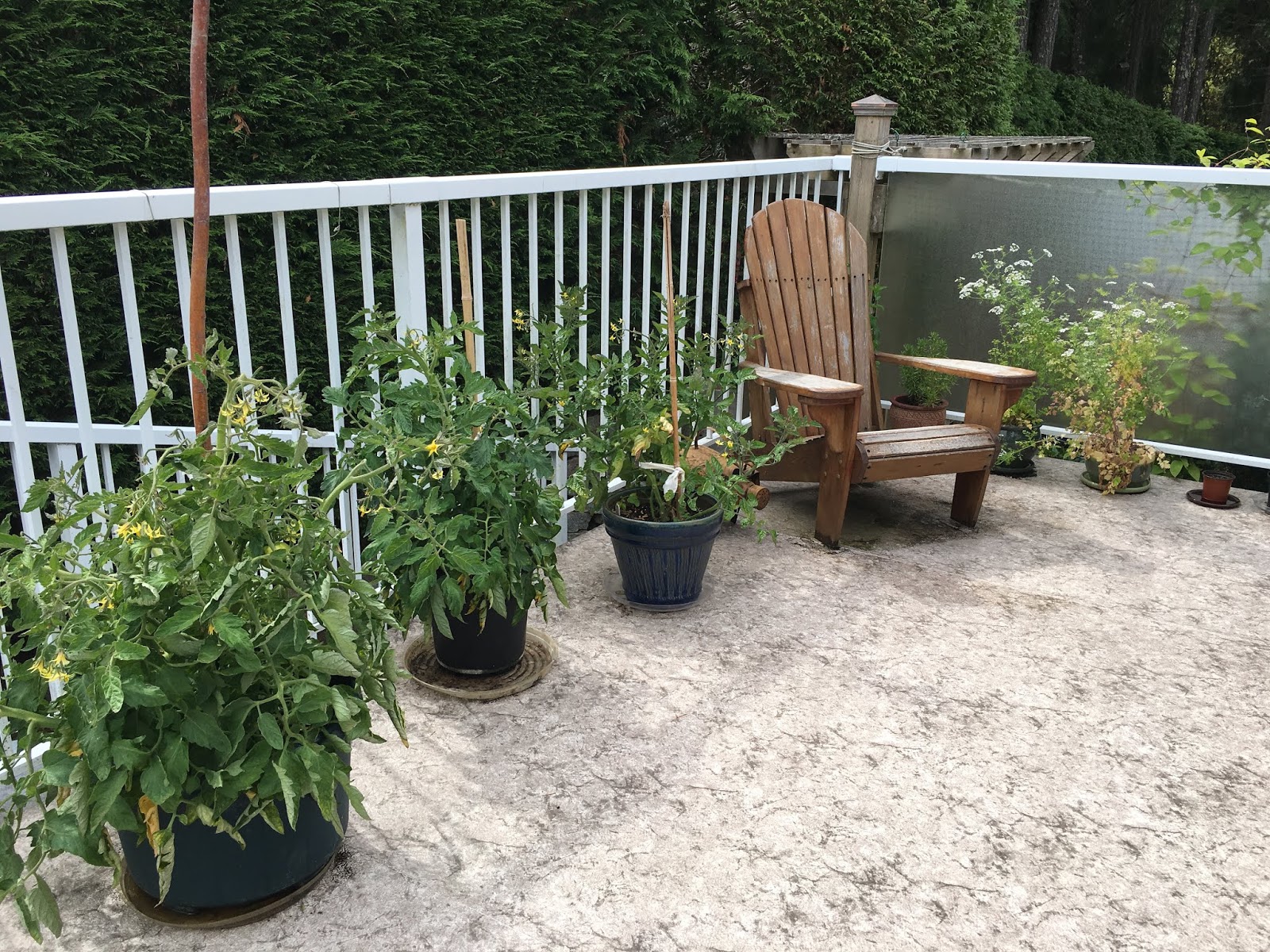
Tomatoes and Herbs on the Deck
Yesterday, I heard something I hadn’t heard for a long time. It was the sound of raindrops pattering down on the roof.

For the last six weeks, we have had no rain. We have been experiencing a drought. The grass outside is yellow and crunchy. The arbutus trees have been dropping their leaves. When I walk along the parched trails, I kick leaves underfoot as if it were autumn.

We live in a coastal rain forest, not the desert. So the rainfall was very welcome.

As a consequence of the drought, our area has water use restrictions. We can only water our yards and gardens for a few hours every second day. (Vegetable gardens are exempted.) We are asked not to use water to wash cars or to hose off driveways.

We have installed soaker hoses to water the shrubs. We don’t water the grass or use a sprinkler. We’ve used lawn clippings to mulch the gardens.

This is the third consecutive summer of drought in this area. Although I haven’t lived on Vancouver Island long, local people tell me that this weather pattern is atypical. The fire risk as at a high level and it is still only June.

The recent hot dry summers in this area are most likely a consequence of climate change. A recently released report on the changing climate said that Canada, especially the more northerly parts, can expect more degrees of warming than the world average, due to the climate crisis. One reason is that as the glacial ice and snow in the arctic and on the mountain tops melts and is not replenished, light from the sun will be absorbed rather than being reflected by the white snow. That will warm the land and air, causing the remaining glaciers to melt even faster.

The more I educate myself about climate change, the more worried I become. The consequences of rapid warming for human civilization, animals, and plants are dire.

But there are positive changes taking place too.

People are now talking about climate change. It is a topic in the media now, whereas for so many years the topic seemed to be avoided. Now our national broadcaster, CBC, regularly reports on climate related issues as well as solutions that individuals, communities, and various levels of government are implementing. Cities, and regional districts like mine, are developing policies and plans to reduce their carbon footprint and take action to mitigate climate change. For example, my regional district has been very proactive in developing a solid waste management approach that diverts waste from landfills. Each household recycles, sorting their household waste into compost (food and yard waste), paper products, recyclable plastics and metals, and garbage (for the landfill).

Since I last wrote about this topic, I have continued to look for additional ways to do my part to reduced my carbon footprint. Here is a list of new I initiatives I have taken in the last two months.

1. I met with my financial advisor and divested my retirement portfolio of fossil fuels. I replaced those mutual funds with funds that are investing in green technology.

2. Reduced beef/lamb in my diet to once a week.

3. Now do most of my grocery shopping at the nearest store (3 km.) to reduce driving, and if I am in the nearby city anyways, I mostly shop at a locally owned independent grocer that offers local produce, meat, and dairy products.

4. To reduce our water usage, we bought and installed more soaker hoses, we mulched the gardens, and we don’t flush the toilet overnight (ewwww).

5. I convinced my service club to offer a vegetarian alternative at the next community pancake breakfast. Now instead of pancakes and sausage, people can choose to have pancakes and fruit instead.

6. When I put away my winter clothes a few weeks ago and brought out my summer clothes, I realized I have way too many clothes. So I have implemented a shopping moratorium for myself. I will not buy any clothing, footwear, ore jewelry for myself until 2020.

I believe that as individuals make personal changes changes, we will make a difference and also inspire ourselves to change policies and practices at a broader social level.

On a totally different topic, I am heading off on an adventure with my daughter. In my next post, I’ll tell you all about it!


Tuesday, June 4, 2019

The Animals Around Us

Upper Pond With Lotus Bloom

A Haven For Birds, Bees, and Butterflies

As I have mentioned before, we purchased our home from people who were avid gardeners. The entire backyard is beautifully landscaped with shrubs that bloom from spring until the fall, and it also has two ponds and a mini waterfall. It has several birdhouses, a bee house, a bat-house, a bird feeder, and a birdbath.

Our yard is a haven for birds, bees, and butterflies. All summer long, the blossoms are alive with buzzing bees -- bumble bees, honey bees, and other types. I am not very knowledgeable about identifying butterflies, but in the last few days, I believe I have seen both Western Tiger Swallowtail and Pale Swallowtail butterflies in our yard, and a blue butterfly that might be a Blue Copper.

As well, we have many birds. We have a pair of humming birds, one with a green head and one with a red head (a female and male pair of Rufous Hummingbirds, I think). One day when I was out in the yard wearing a red shirt, one of the hummingbirds hovered only a foot away, trying to determine if I was a large red flower, I guess. The same day, a tiny bird of an unknown species that was perched on the rose arbour a few feet from me flew over and was about to land on my head. I felt the whirring of tiny wings just above me. It realized its mistake and continued on.

The birds I recognize include American robins, varied thrushes, juncos, chickadees, and sparrows. There is a yellow bird that looks like a canary (possibly the Common Yellowthroat?), and many other little birds. There are crows, ravens, and Northern Flickers. Just the other day, a Pileated Woodpecker came by and pecked at the trunk of a Douglas fir tree just beyond the back fence. Once a Great Blue Heron paid a visit to our pond. I ran out and counted the fish, but they were all still there.

Sailing past the Douglas fir trees, we frequently see bald eagles, hawks, and sometimes a pair of turkey vultures. Presently, we believe that there is an eagle nesting in one of our Douglas fir trees. We can't make out the nest, but we hear the eagle vocalizing all day long. We've also heard the call of an owl, red winged blackbirds, and ring-collared doves.

We don't use any chemicals of any sort in our yard, and I think that is why it attracts so many species. 


Other Species in Our Yard and Nearby


Vancouver Island Deer
As well as the birds, bees, and butterflies, there are a variety of other animals that share our space. The deer are so commonplace here that I never remember to take photos of them even though I see them almost every day in our yard or around the neighbourhood. The photo above is of a pair of deer at a new house under construction down the road from us.

Bug at the Pond
There are many wild rabbits in the neighbourhood. A large white rabbit with a black spot on its eye and a smaller brown bunny spend a lot of time grazing in our yard. One day when I walked around the streets, I counted eighteen different rabbits on my walk.

One evening, I surprised two raccoons fighting (or mating?) in a nearby ditch. Our next door neighbour has been plagued by raccoons getting into her garbage but fortunately we haven't had that problem.

I've seen two different variants of garter snakes in our yard, and Rob spotted either a salamander or lizard in the garden the other day. Sometimes a little green tree frog shows itself. We have all manner of interesting insects, including June bugs, dragon flies and damselflies. As well, we have various slugs and worms, and in the pond there are snails and leeches.

Goldfish at Feeding Time
 Our lower pond has goldfish in it. I am fascinated with the goldfish, and spend lots of time watching them each day. This winter, we wondered if they had survived as we did not see them for months. But once the water warmed up in the spring, they reappeared. Most of them made it through the winter. There were thirteen fish when we first moved here two years ago, and we now have approximately twenty-eight fish. The goldfish have been having babies! The minnows are black, grey, or brown. As they mature, they turn orange. Some of the mature fish are orange and white, and one large fish is all white.
 
Canada Geese
I also see lots of animals in the forests around us, and in the nearby little lake and ponds. On a recent mountain bike ride, I paused for a break, and a skunk walked calmly across the path I had just ridden down. I stayed very still and watched the cute little cat-like animal stroll by. 

On my forest hikes, I often stand by one of the many ponds to see what I can see. The largest pond is home to many ducks (buffleheads, mallards). One day, the two Canada geese shown in the photo were there. They were disturbed by my presence and kept swimming back and forth in front of me, honking loudly. I went back on the trail and came out again at a different viewing spot. The two geese spotted me instantly and swam over to chase me away. That same day, I saw some Brant geese come to the pond. Brant geese are a protected species that migrate through this area in the spring. When the Brants tried to land, the Canada geese chased them away.

Clams at the Estuary
I have read that there are at least six cougar dens on this peninsula where we live. Although my son and my neighbours have seen cougars here, I haven't seen one. There is reported to be a resident bear. I haven't seen it, but I did see a bear this spring in nearby Coombs. It was on the bike path, so we took a little detour on our bicycles.

My Daughter and Oysters

Abundant Ocean

Our peninsula is surrounded on three sides by the ocean and its great abundance of life. Last week, there was a pod of Orcas (Killer Whales) in the bay on the far side of the peninsula. I didn't see them, but a number of people posted pictures and videos.

There are many sea lions and seals here. In the spring and fall, from everywhere in the area you can hear sea lions barking. We have not gone fishing much, but when we went out on our friend's boat last week, Rob dropped a line. He caught and released a small ling cod. Last week, hiking along the shore with my daughter, I saw sea stars and sea anemones. We gathered some oysters and few clams.

Kate Takes a Breather
We don't have an oyster knife for shucking oysters, but we managed to shuck them using a screwdriver and one of Rob's sturdy knives. We each slurped down a couple of raw oysters, and the rest of the dozen went into a seafood chowder, along with a handful of clams. Delicious! Afterwards, we returned the shells to the beach. (Note that we carefully read the government website beforehand to make sure that we were gathering the shellfish in an area that was safe and permitted.)


The Pets

Oliver Sitting on my Legs
Of course, no blog post about animals would be complete without mentioning those important fur-covered family members, Kate and Oliver. Kate is our elderly Blue Heeler cross. She still loves her hikes and walks with me, but now I have to take it slowly and give her lots of rest breaks. She also likes to cool off along the way in a pond or the lake.

Oliver, our cat, also is elderly. He is quite hobbled with arthritis. He loves to bask in the sun, or sleep on a chair out on the deck. If we're in the yard, he follows us around. He's a very cuddly guy.


A Frog Story

A Frog in Our Pond
This spring, a frog appeared in our pond. I was thrilled to welcome this new pond resident. At first, every time I came near the pond, it jumped into the water. But after awhile, it became used to me and would just sit there blinking and sunning itself as I fed the fish.

A few days ago, I went online to try to determine what type of frog it was. We have a serious problem on Vancouver Island with an invasive species of frog, the American Bullfrog, which has been taking over wetlands and killing native species of frogs. It is a voracious predator that can eat fish, mice, painted turtles, salamanders, ducklings, and other small birds. That's why I was so excited to welcome what I thought was a native species of frog to our pond. I believed our frog was not an American Bullfrog because it was smaller than other bullfrogs I've seen, and also because it didn't produce the easy-to-identify bullfrog croak.

So, I was horrified to discover from my research that our frog was, in fact, an American Bullfrog -- a female one. Rob set up a special USB camera with a computer so we could zoom in on it to make a positive identification. Females are unable to vocalize. They can travel quite a long way to get to a pond, where they will lay up to 50,000 eggs at a time. I frantically read websites about the history of the bullfrog's introduction to the area (one website said they were brought in by restaurant owners who wanted to serve frogs' legs and when the business failed, released into the wild), watched videos of them eating all manner of things, learned that they carry amphibian pathogens, and looked at maps showing that their territory is expanding. I had a sleepless night worrying that we were harbouring an invasive species and that our pond soon would be full of bullfrog tadpoles.

Meanwhile, Rob read the frog control website to learn how to exterminate it, and then calmly followed the instructions while I refused to watch. Invasive species or not, I had become fond of "our" frog. But culling it was the right thing to do, and I am grateful that Rob was willing to do it. We no longer have a bullfrog in our pond.

Thursday, May 23, 2019

So Where Have You Been, Dr Sock?

I haven't posted for so long that you might have thought I'd disappeared somewhere. I've hardly been keeping up on reading my favourite blogs, either.

Good Life, Good Food
Well actually, I've been right here. I made one quick trip to northern BC, but mostly I've just been here at home, living my life.

We've had some friends and family visiting over the past month.

My brother was down here for a visit in late April.We had a great time.

Trail at the Point
We showed him some of our favourite hiking places.

Also the beach, of course!


With My Bro


We also biked the Parksville to Coombs Rail Trail there and back, with a nice stop for lunch in Coombs at the famous Goats on the Roof. It was great to get out on the mountain bikes for the first time this spring. Since then, we've cycled the Rail Trail once more, and also the trails around Enos Lake.

Intrepid Cyclists
We had a visit from my son, who has just returned from a holiday in Barbados. We're looking forward to a visit from my daughter next week.

Our friend Cliff has been visiting too. Last week, we spent an afternoon out on Cliff's ranger tug cruising along beaches and around islands.

Ahoy Captain!
At the Marina
Livin' The Dream
Easter was a big hit with the grandkids. I can explain it in one word: chocolate!

Face Paint and... Chocolate!
My Booth at the Spring Showcase


The last weekend of April, my art group hosted a Spring Showcase. It was well attended and we had a number of guest artists join us this year. You can read more about it here.

The weekend after the art show, I attended a writers' conference. Several members of my writers' group went as well.

I've also been busy with volunteering activities. I volunteer a couple of times a month at my grandson's preschool. Our service group hosted a community Easter Egg Hunt. We also joined the Broombusters' initiative, and spent an afternoon cutting scotch broom around the community centre. Broom is an invasive plant in our area that suppresses native species, is toxic to other plants and animals, and creates a fire hazard. Invasive species are the second greatest cause of loss of species diversity around the world.

Rob Cutting Broom

During April, I spent three weeks participating in the Drawdown Eco-challenge. Participants' focus during the eco-challenge was to commit to making personal changes to reduce their individual impact on global warming. I chose two daily challenges: to eat two meatless meals a day, and to walk daily in nature. As well I completed several one-time challenges, including: creating a compost bin in my yard, mulching trees and shrubs, learning about electric vehicles, learning about heat pumps, and donating to purchase clean cook-stoves in developing countries. There were many options to choose from, including challenges that involved collaborating with community groups or communicating with local leaders to influence environmental policies.

The Drawdown organization eco-challenge that I participated in is not the only chance to get involved. There is a July challenge to go plastic-free. There are also a number of other groups doing great work to reduce global warming and to mitigate the effects of climate change, such as 350.org and Blue Dot. I plan to continue to educate myself and to make changes to reduce my carbon footprint. I have come to understand that the human race has reached a critical juncture and that we need to make sweeping changes now if we want to leave a liveable planet for our children and grandchildren.

I haven't been giving the garden the attention it deserves, but somehow it still manages to look beautiful. My potato, strawberry, and tomato plants are thriving, as are the pots of herbs. However, I can't seem to get the spinach to grow. Bunnies, perhaps?

Tuesday, April 16, 2019

Art is on my Mind

Hiking With my Trusty Companion
It’s April and art is on my mind. The days are becoming longer and sunshine has sharpened the colours. The daffodils are waving their yellow heads, and one by one the shrubs in my garden are bursting into flower. As colour returns to the coast, I feel the urge to paint.

A Fallen Leaf
The natural landscapes around me have always inspired my creativity. I walk the trails observing all the signs of Spring, and it feeds my soul. The other day, I made a point of counting how many types of wild flowers I saw along the trails. There were 13. Yes, I counted the dandelions and skunk cabbages too!

Unidentified Spring Flower
Last week, I went to the excellent artist's supply store that serves the mid-Island area. I spent a happy hour choosing some tubes of paint, a couple of new brushes, and some other products like varnish and primer (ground). I am not much of a shopper except in art stores, bookstores, and stationery stores. Once I enter one of those three types of stores, my self-control deserts me. I might as well open my wallet and dump all the money out.

I came home feeling inspired and varnished ten of my paintings. Varnishing the surface of the painting helps to protect the painting and restores the colours to the brightness they had when the work was first painted. You can’t put permanent varnish on an oil painting until the paint has time to cure (fully dry), which takes about a year. I have not been conscientious about remembering to go back and varnish finished works. It is not a necessary step, but I do like the way it enhances the brightness of the colours.

View of Nanoose Estuary
On a recent walk, I took the photo above of Nanoose Estuary with the tide out. I started a painting last Fall of this scene, working from a photo taken near this spot. The painting is still sitting on my easel, unfinished. Somehow -- I don't know how this happened -- I have signed myself for so many things that I hardly seem to have any time to paint.

Here's a list: Weekly yoga classes at two different studios, book group, writer's group, service group, weekly volunteer activity for service group, volunteer at grandson's preschool, art group, planning committee for upcoming art show, organizer for activity to combat invasive plants, academic committee, Elder College course, participant in Drawdown Ecochallenge 2019, and, um, lots of other stuff.

I just want to put in a plug for Drawdown Ecochallenge. This is a three-week challenge in April, in which people from all over the world commit to do one or two or more things to contribute to efforts to combat (and eventually reverse) global warming.

There is still time to join! I would be happy to have you join my team, Vancouver Island Sustainable Future (you don't have to be from Vancouver Island). This is my way of taking action, rather than just sitting around worrying about it. If you join, you can read my feed on the Ecochallenge and find out all about my eco efforts this month. You can join up here.

It's only ten days until our big Spring Showcase art show! I have updated my art website, and added more paintings to it. You can read about the upcoming show here.

Sunday, March 17, 2019

A Plan to Reverse Global Warming

A Path Through the Forest

What Can I Do?

In a recent blog post, I wrote about my sense of helplessness and personal paralysis as I considered what I can do to help address global warming and climate change. The problem is huge and multi-faceted, and change on a global scale is urgently needed for humanity's survival (or, perhaps more accurately, the survival of human civilizations).

As a single individual, I cannot solve climate change. But I can do my small part to make a difference, to the best of my ability.

So where should I put my efforts? What actions would have the biggest impact, match my particular knowledge and skill set, and be within the scope of what I can actually accomplish?

Although I have been slowly educating myself about the challenge of global warming facing us as a species, I decided that I needed to do some reading about not just the challenge facing us, but about possible solutions.

Drawdown

So I ordered the following book from the library: Drawdown: The Most Comprehensive Plan Ever Proposed to Reverse Global Warming. It arrived a couple of days ago. This book, edited by Paul Hawken and published in 2017, was a New York Times best seller in 2018. There also is a website that is even more extensive and up-to-date than the book at www.drawdown.org.

So what is "drawdown?" The website defines it this way: "Drawdown is that point in time when the concentration of greenhouse gases in the atmosphere begins to decline on a year-to-year basis." Once greenhouse gases begin to decline, the warming of the planet will begin to reverse.

The book sets out 100 global strategies, which, if we implement them all by 2050, will enable us to reverse global warming. The strategies are in the following categories: Energy, Food, Women and Girls, Buildings and Cities, Land Use, Transport, Materials, and Coming Attractions (promising future technologies and solutions).

All of the approaches (except the last category which is more speculative) already exist and have been rigorously researched and modeled by a team of more than 200 scientists and other specialists from around the globe. Each one is ranked in terms of how many gigatons of carbon dioxide (and other greenhouse gases) will be reduced by 2050 using that solution, an estimate of how much it will cost to implement, and what the net savings will be. By reduced, I mean either CO2 that will be removed from the atmosphere, or CO2 that would be added if we continue on our current course but that we will avoid adding if we use this solution.

In the book, they have adopted a conservative bias -- that is, left room for error if the proposed solution is not quite as effective or adopted as readily as the scientific evidence suggests is plausible. 

Upon receiving the book, I looked at the Table of Contents and how the book was organized. I read the brief Forward that described the purpose of the book and the assumptions they worked within. Then I flipped straight to the back of the book and read the table of statistics (yes, I'm a nerd).

The numbers show that, by 2050, in the Plausible Scenario (the outcome that we should be able to achieve with good effort), we will be able to reduce 1,051 gigatons of carbon dioxide. That will not get us to drawdown or reversal of global warming. In order to reach drawdown, we will need to reduce carbon dioxide by 1442.3 gigatons. This is the Drawdown Scenario, and they describe how it can be achieved. They also show an Optimum Scenario -- one where we are able reduce carbon dioxide by 1612.9 gigatons.

I also skimmed through the brief bios of the 200 scientists and other experts from around the world who contributed to this research and plan.

My Initial Response

 My first thoughts on getting this far with the book were:
  • a huge sense of relief that so many really smart people with appropriate backgrounds are working on developing solutions and a plan
  • surprise at the wide range of human activities that are currently contributing to the problem, and the practical solutions in each area. 
  • a dawning realization that we have to work on the problem of global warming on many fronts simultaneously -- electric cars, solar power, and wind turbines are not by themselves a solution. They are only part of the solution. 
  • surprise to see that the data shows that the net savings of implementing "greener" solutions exceeds the costs. That is, green solutions are in most cases less expensive than what we are currently doing. 
 I also appreciated that the book is very engaging and interesting to read, not dry and technical as so many reports about climate change and policy frameworks tend to be. It is beautifully illustrated with photos of different landscapes and cultures around the world.

So I dived into the meat of the book.

Drawdown, Open to the Section on Food

Food

I decided to start with the section on food, because I am very interested in food.

I was surprised to learn that a broad-based switch to eating a plant-rich diet is one of the most effective ways of reducing greenhouse gases -- ranked 4th of the 100 solutions. They point out that our "Western diet comes with a steep climate price tag," noting that raising livestock accounts for 15 to 50 percent of current greenhouse gases emitted each year. A large proportion of this is because of the deforestation that takes place in order to create grazing areas for cattle, in particular.

They report that the average Canadian and American eats more than 90 grams of protein each day, much of it from meat and animal products. An adult's daily protein requirement is 50 grams and all or most of it can be obtained from plant-based foods.

They recommend reducing meat consumption and avoiding overeating by restricting calorie intake to 2500 calories per day, on average. Citing Thich Nhat Hanh, a Zen master, they say, "making the transition to a plant-based diet may well be the most effective way an individual can stop climate change."

As I have written here before, I eat a healthy well-rounded diet that includes meat. But this book convinces me that reducing my meat consumption is something immediate and positive with respect to climate change that I as an individual can do.

Another astonishing source of CO2 in the atmosphere is from food wastage. More than a third of the food we grow or raise every year in the world is thrown away, primarily in high-income economies. Yet around the world people are going hungry.

The wasted food contributes the equivalent of 4.4 gigatons of carbon dioxide every year. If we used the food instead of throwing it away, globally we could reduce the need to clear more land to grow food, which causes deforestation. Reversing food wastage is ranked third of the 100 solutions in terms of carbon dioxide reduction. If by 2050 we only threw away half as much food as we do presently, we could reduce CO2 by 70.5 gigatons, they say.

Some of the other topics I have read about include farmland restoration (#23), clean cookstoves (#21), multistrata agroforestry (which means planting crops under trees) (#28), improved rice cultivation (#24), growing rice using the system of rice intensification (#53), and silvoculture (grazing livestock in forests) (#9).

There are still several other strategies that involve food and agriculture that I have yet to read about. It is interesting to discover that so much of our greenhouse gases come from our systems for raising and handling food.

Michael Pollan's advice: Plant a food garden in your yard or community. Because of our industrialized approach to agriculture, every calorie of food produced requires 10 calories of fossil fuels to produce it. Therefore, he says, growing your own food is one of the most powerful things you can do. 
 
Why It Matters

To me, the reason that it is imperative to take action is that the well-being of future generations rests on the choices we make right now. Every month that we delay, we pump more greenhouse gases and particulate into the atmosphere. Some of them, like carbon dioxide, remain in the air for decades or even centuries. Others, like black carbon, only stay in the air for eight to ten days, but hugely accelerate the warming effect when they are present.

Taking action now means that our grandchildren and our loved ones' grandchildren will inherit a beautiful world in which they can thrive. The alternative, if we do not take action, is too horrible to contemplate.

I'll leave you with some photos of me on a recent hike with my son and daughter.